The Emotional Work Nobody Preps Founders For Before a Sale

What kills a deal six weeks before close — after the price is agreed, the diligence is clean, and everyone on both sides wants it done?
Almost never the economics. Ask anyone who has watched an LOI die at the eleventh hour and the autopsy reads the same way. A founder who spent eighteen years building the company starts adding conditions. Terms he already agreed to come back with new language. A clause he never mentioned becomes a hill to die on. The buyer assumes it’s a negotiation tactic. The advisor assumes cold feet. Both are wrong.
He’s grieving. He just doesn’t have a word for it yet, and neither does anyone in the room.
The Question Sellers Can’t Answer
Denise Logan, who wrote “The Seller’s Journey” and spends her time inside stalled M&A deals, frames the whole problem around one question: “What does work provide beyond money? Owners don’t know until they articulate it. Without that answer, they’ll sabotage the deal.”
Read that again. Not might sabotage. Will.
This is the part of exit planning nobody schedules. Founders spend years optimizing the thing they’re selling: the P&L, the customer base, the recurring revenue. They spend roughly zero time on the person doing the selling. The whole apparatus of a deal is built to answer what is the business worth. Almost none of it touches who is the seller without the business.
That gap is where deals go to die. Not in the quality of earnings report. In the founder’s head.
”99% Right Is 100% Wrong”
Here’s what makes this so hard to catch. On paper, everything can be aligned. Price, structure, timeline, cultural fit: all of it can check out, and the deal still collapses in the final stretch.
Here’s the blunt version: ninety-nine percent right is one hundred percent wrong. Every economic term can be perfect. Price. Structure. Timeline. None of it touches what identity looks like post-close. If the founder hasn’t done that internal work, the one percent he skipped is the only percent that matters.
You’ve seen the symptoms even if you didn’t name the cause:
- Last-minute demands that make no economic sense: a founder torching real value over a term he can’t quite explain.
- Terms you already closed resurfacing weeks later with new conditions.
- A seller who keeps “needing to think about it” on things both parties resolved a month ago.
- Cold feet dressed up as hard-nosed negotiation.
None of that is about the money. It’s the sound of someone trying, at the worst possible moment, to answer a question he should have answered years earlier. The deal is tracking one reality and the seller is living another. No workstream in the entire process is pointed at the second one.
Matt Salisbury, an EVP at a strategic advisory firm, puts the buyer-side observation next to Logan’s: “Sellers treat exit as purely financial transaction, ignoring the emotional weight of letting go.” Two people looking at the same wreckage from opposite sides of the table, describing the same thing.
What Work Actually Provides
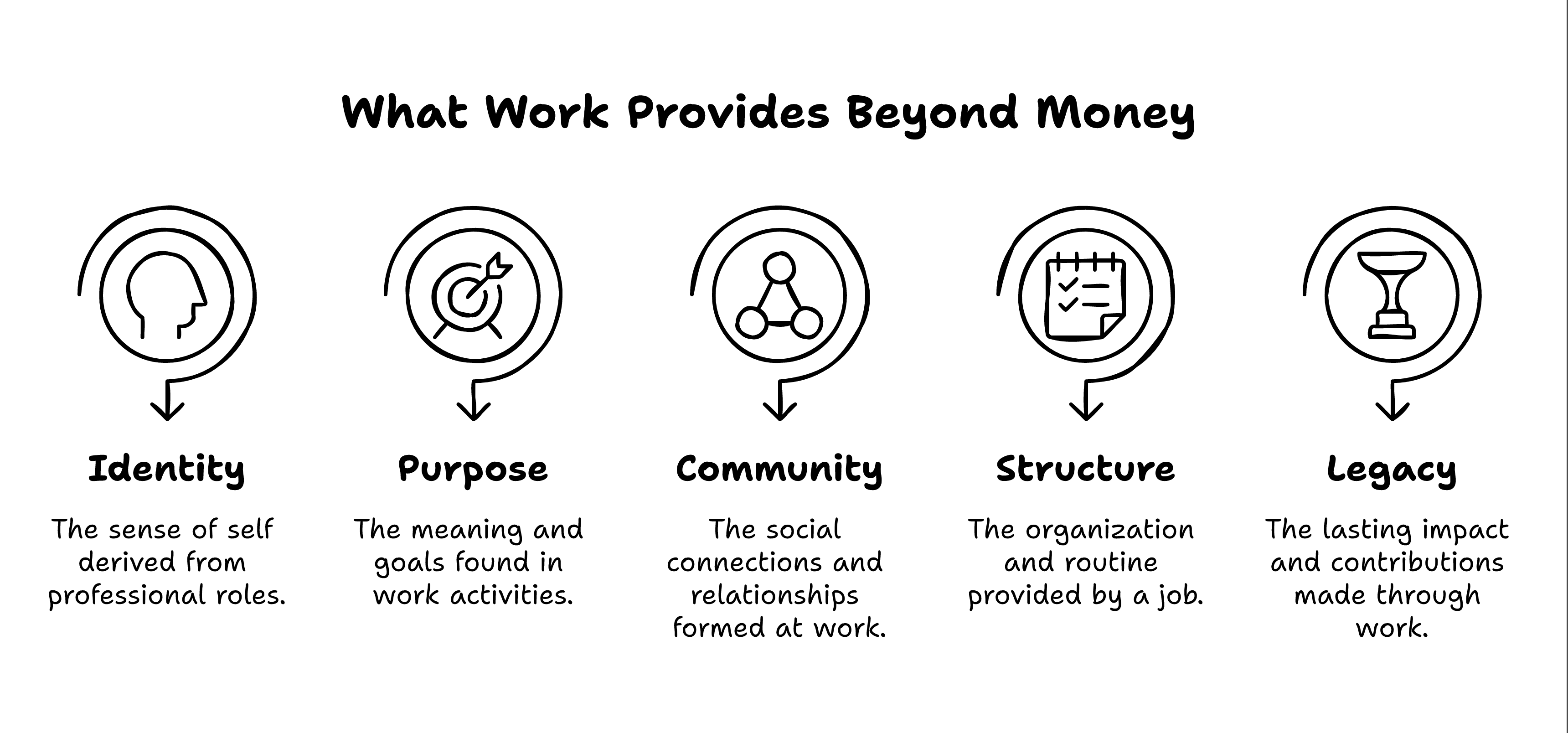
So answer the question honestly: beyond the wire transfer, what does this company give you? For most founders it comes down to five things, and each one is a specific thing you’re about to lose.
Identity. “I’m the founder of X” is not a job description. It’s an answer to who are you. Strip the company away and a lot of founders don’t have the next sentence ready. That missing sentence is the deal risk.
Purpose. The reason you get up. For years the company was the answer by default. Sell it and the default disappears, and “figure it out later” is not a plan. It’s a vacuum you’ll try to fill by clawing the company back.
Community. Your employees, your customers, your suppliers, the people who text you. That’s a tribe, and you built it. Selling doesn’t just transfer equity; it resigns you from the group.
Structure. The Tuesday meeting. The rhythm of a week. The scorecard that tells you whether today was a good day. Founders underestimate structure until it’s gone and the calendar is suddenly, terrifyingly blank.
Legacy. What happens to the thing you made once your name is off it. Will the new owner keep the team? The brand? The way you did things? Not knowing is enough to make a rational person walk from a great price.
The money exists at close. Whether it replaces anything (the identity, the purpose, the tribe, the Tuesday meeting) is a separate question, and it’s the one that determines whether the founder signs.
Begin With the End
The fix is almost annoyingly simple to state and hard to do: exit planning starts the day you start the business, not the year you decide to sell.
Not the financial planning. The emotional planning. The founders who close cleanly worked out who they are apart from the company long before the term sheet arrived. The ones who sabotage are doing that work in real time, under maximum pressure, in front of a buyer.
If you’re a founder who might sell someday, which is every founder, the work is concrete:
- Write down what work provides beyond money. The five things above. Be specific, not aspirational.
- Have the real conversation with your spouse or family, the one about what your Tuesday looks like the week after close.
- Imagine year one post-close in actual detail. Not the highlight reel. The Wednesday afternoon with nothing on the calendar.
- Name the grief. You built something and you’re letting it go. That’s a loss even when it’s the right decision. Process it before the term sheet, not after.
Do this early and the sale becomes a transaction you can execute. Skip it and the sale becomes an identity crisis you’re trying to negotiate your way out of, in public, on a deadline.
Why This Is a Buyer’s Problem Too
If you’re an independent sponsor or an operating partner, this isn’t the seller’s issue to sort out on his own. It’s the single most predictive variable in whether your LOI survives to close, and it’s the one category most buyers never screen. Every other workstream in your process validates the spreadsheet. None of them validates the seller.
I’ve written before about how the same broken-LOI pattern traces back to seller readiness, and the practical questions you can ask pre-LOI to surface it. That piece is the buyer’s checklist. This one is why the checklist works: what you’re screening for is seller psychology: whether the founder has done the emotional work, or whether you’re about to spend six months discovering he hasn’t.
The tell is in the vague answers. “What will you do the day after close?” met with “travel, I guess” is a founder who hasn’t touched any of the five things. So is deflection. So is “I haven’t really thought about it.” A seller who can describe post-close life in specific terms has already done the grieving. A seller who can’t is going to do it during your deal, on your timeline, with your capital committed.
That’s the same instinct good operators bring to the other side of the transaction, reading whether the people match the thesis before the money moves. It’s just pointed at the seller instead of the management team.
The Stakes
For the founder, the cost of skipping this is a deal that dies at the finish line — or worse, one that closes and curdles into regret, because the money never replaced the identity, the purpose, or the tribe. For the buyer, it’s six months and five figures of legal spend chasing a deal that was never psychologically ready to close.
Either way, the question is the cheapest diligence in the entire process. It costs one honest conversation. There’s an entire advisory specialty built on the fact that almost nobody has it in time.
So have it early. If you’re a founder, answer what does work provide beyond money before you hire an advisor, not after the buyer catches you flinching. If you’re a buyer, ask some version of it before you sign the next LOI, and listen hard to whether the answer is specific or a shrug.
The economics are the easy part. The founder’s head is the deal.
Alex Escoriaza helps PE-backed companies and independent sponsors figure out what they’ve actually bought, and whether the data, operations, and people match the deal thesis. If you’re working through a deal or a post-close transition, let’s talk.