

You just closed on a business. You have a transition plan. You have ideas about where you want to take this company.
Your employees are wondering if they’ll still have a job next month.
That’s the gap nobody talks about in deal prep. You’re thinking about growth, operations, value creation. They’re thinking about survival. And until you close that gap, nothing else you want to do matters.
The Credibility Deficit
Here’s what makes day one so difficult: you have zero credibility with the team you just bought. None.
The previous owner earned that trust over years, maybe decades. You inherited the company. You didn’t inherit the trust. It doesn’t matter what your background is or how good your intentions are.
Ruchik Gandhi bought a services company and ran straight into this. His workforce came from cultures he wasn’t familiar with. “I didn’t know how to get through to them and crack through,” he said. The technical skills to run the business were one thing. Earning trust across cultural barriers was something else entirely.
This catches acquirers off guard. You prepared for the financial complexity. You prepared for the operational learning curve. You probably didn’t prepare for the fact that 30 employees are going to watch everything you do for the first six months and decide — based on your actions, not your words — whether you’re worth following.
Every decision gets interpreted through a lens of “what does this mean for me?” The first person you let go, the first process you change, the first meeting you skip — it all gets catalogued. You’re being evaluated by people who didn’t ask for this transition and aren’t sure it’s going to work out.
And here’s the compounding factor: in most small and mid-size businesses, a handful of people hold everything together. They know the customers, the workarounds, the processes that keep the operation running. These people have the most leverage to walk. If they decide you’re not trustworthy, you lose the institutional knowledge that makes the business function — the same knowledge that doesn’t always survive founder transitions even under the best circumstances.
How Acquirers Actually Build Trust
The theory is straightforward. The execution is where it gets interesting.
Show up. Physically. Immediately.
Julia Grant-Hensel acquired a company with a team based in Romania. Her first move after closing? She “flew out to Romania very quickly after we closed to meet with everyone on the team and learn about what they do.”
Not a video call. Not an email. A flight to Romania. When the new owner shows up in person, it sends a signal that can’t be sent any other way: this isn’t a financial transaction — it’s a relationship. You’re investing time, not just capital.
Resist the urge to fix things immediately.
You’re going to see problems. Processes that are inefficient. Systems that are outdated. Decisions that don’t make sense to you. Your instinct will be to start fixing them.
Don’t. Not yet.
I know. Every consulting instinct says otherwise. You see the problem, you know the fix, and waiting feels like wasted time. It isn’t.
Every change you make in the first few months gets interpreted as criticism of how things were done before. The people who built those processes are still in the building, watching. Ask questions instead. Ask why things are done a certain way. Ask what’s been tried before. Ask what the team would change if they could. You’ll build more credibility through genuine curiosity than assumed authority.
The most extreme version of this? Go undercover.
Linh Tran acquired a commercial services company and did something most acquirers would never consider. He went undercover as the IT guy. For 18 months.
He owned the company and nobody knew. He showed up every day, fixed computers, sat in meetings, ate lunch with the team. He learned how the business actually worked — not how the P&L said it worked, but how people made decisions, where the friction was, who the real leaders were regardless of title.
Under his ownership, the company grew from $300K to $5M in EBITDA. But the point isn’t that you should disguise yourself as an IT consultant. The point is that Linh Tran understood something most acquirers miss: trust comes from proximity, not authority. He earned credibility at the ground level before ever exercising the power of ownership.
Eighteen months is extreme. But the principle isn’t. The more time you spend understanding the business at the operating level — not the management level, the operating level — the faster trust develops.
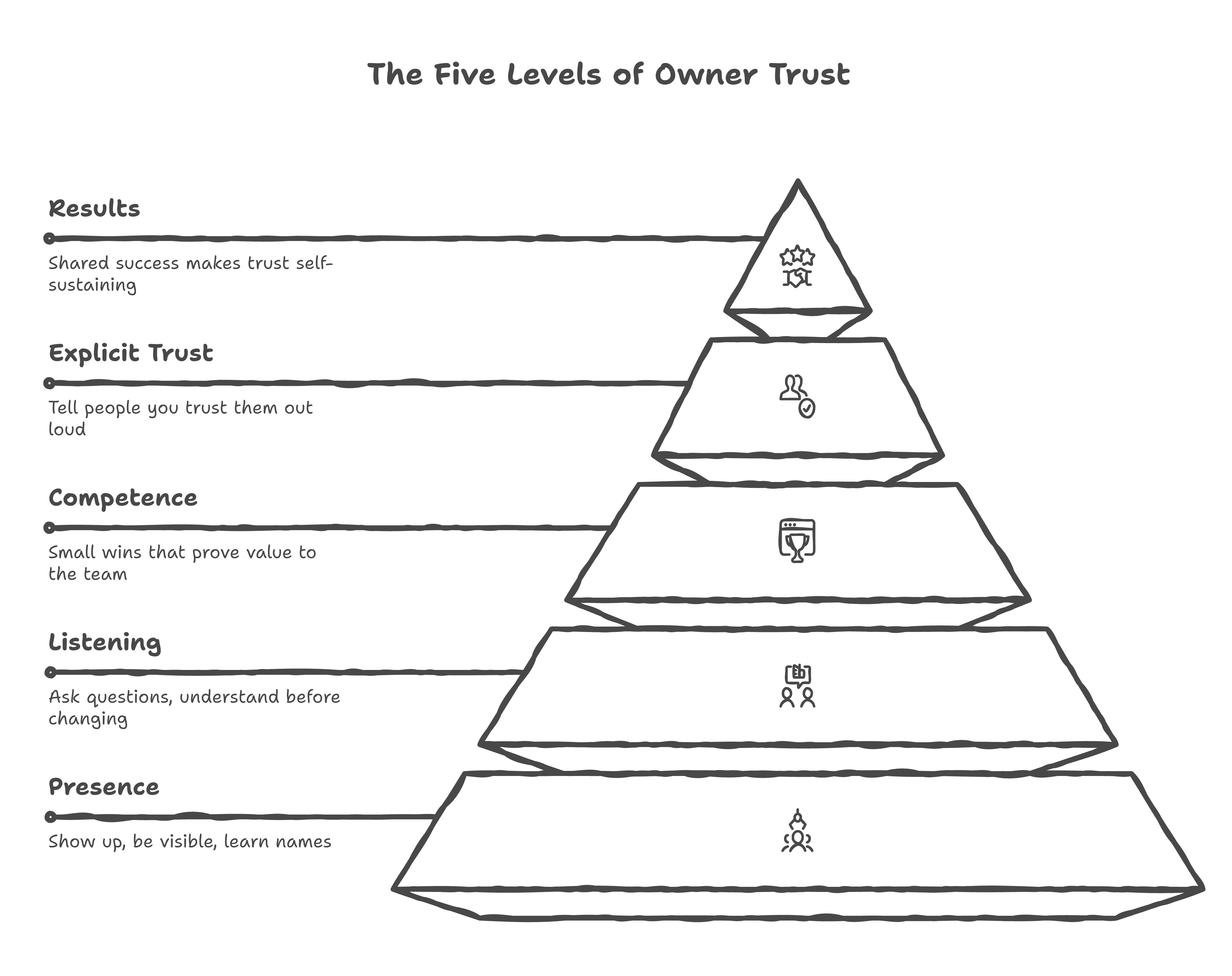
The Trust-Building Hierarchy
Trust doesn’t arrive all at once. It builds in layers, and you can’t skip levels.
Presence comes first. Show up. Be visible. Learn names. Walk the floor, visit job sites, sit in on team meetings. The team needs to see you before they can begin to trust you.
Then comes listening. Once you’re present, shift into learning mode. Ask operational questions. How does this order get processed? What happens when a customer complains? Why do we use this vendor? Every question shows respect for the knowledge your team carries.
Competence earns the next level. Demonstrate that you can add value — not by overhauling everything, but through small wins. Fix a problem that’s been bugging the team for months. Approve a resource request the previous owner kept deferring. These small moments compound.
Sarah Chiles took over a local business and earned trust this way. “We get so much feedback about how well the shop is running now and the team we’ve established here and we’ve gained local trust,” she said. What built trust: results the team could feel, not strategy management could measure.
Explicit trust comes next. Jeremy Hunka, who hired a CEO to run his acquisition, put it simply: “I trust you. I’m not going to be here every day.”
That statement is radical in a small business context. Employees in acquired companies expect oversight, not autonomy. When the new owner says “I trust you,” it shifts the dynamic from “prove yourself to me” to “we’re in this together.”
Results cement everything. When the team succeeds together — wins a contract, hits a milestone, solves a hard problem — the owner’s credibility becomes proven, not theoretical. And proven trust is durable. It survives the disagreements and difficult decisions that come later.
The Trust Plateau
Here’s what nobody tells you: trust-building feels like nothing is happening for a long time, and then everything shifts.
The first few months are awkward. You’re showing up, asking questions, trying not to break things. The team is polite but guarded. Key employees are still updating their resumes, just in case. You’re making decisions with incomplete information because the people who have it haven’t decided yet whether to share it.
This is normal. You’ll be tempted to assert authority just to feel like something is happening. Resist that temptation.
The shift happens when one person — usually someone respected by the team, not necessarily the most senior — decides you’re credible. They start sharing information you wouldn’t have gotten before. They defend your decisions in conversations you’re not part of. Their endorsement carries more weight than anything you could say yourself.
You can’t manufacture that moment. You can only create the conditions for it by being consistently present, genuinely curious, and visibly competent.
What’s at Stake
Every operational change you want to make requires trust. New reporting system? Trust. Team restructure? Trust. Compensation changes? Trust. The honest answer when you ask “what’s really going on?” Trust.
Without it, you get compliance instead of commitment. People follow the new process but keep the old spreadsheet as backup. They nod in meetings and vent in the parking lot. This is the same dynamic that derails post-acquisition changes of all kinds — the gap between what leadership assumes is happening and what the team is actually doing.
With trust, you get the real version of the business. People tell you about problems before they become crises. Key employees stay through the transition. The institutional knowledge that makes the company valuable transfers to the new operating model instead of walking out the door.
Trust isn’t the culture initiative you’ll get to eventually. It’s the prerequisite. The thing without which none of the other things work.
If you’re in the first year of owning a business and frustrated that changes aren’t sticking, ask yourself: have I earned the trust to make them?
Alex Escoriaza helps PE-backed companies turn messy data into operational clarity. If you’re in the first year of ownership and the changes aren’t sticking, that’s exactly the kind of transition I help with. Reach out.