
You would never let a portfolio company run its sales pipeline the way most independent sponsors run their deal pipeline.
Take the first board meeting after a close. You ask the CEO how many leads came in last quarter, which channels produced them, and what converted. If the answer is a shrug and a story about two big wins, you are planning a CRM cleanup before the coffee is cold.
Now turn it around. How many teasers did you see last year? Which bankers sent the ones that reached an IOI? What share of your LOIs came from relationships older than three years? For most sponsors the honest answer lives in an inbox, a spreadsheet with four tabs, and a feeling about which bankers like them.
Deal sourcing is the first funnel an independent sponsor ever runs, which makes it the first analytics problem too. Treat it that way and you know where your closes came from. Treat it as a feeling and you are guessing.
The Funnel Math Nobody Writes Down
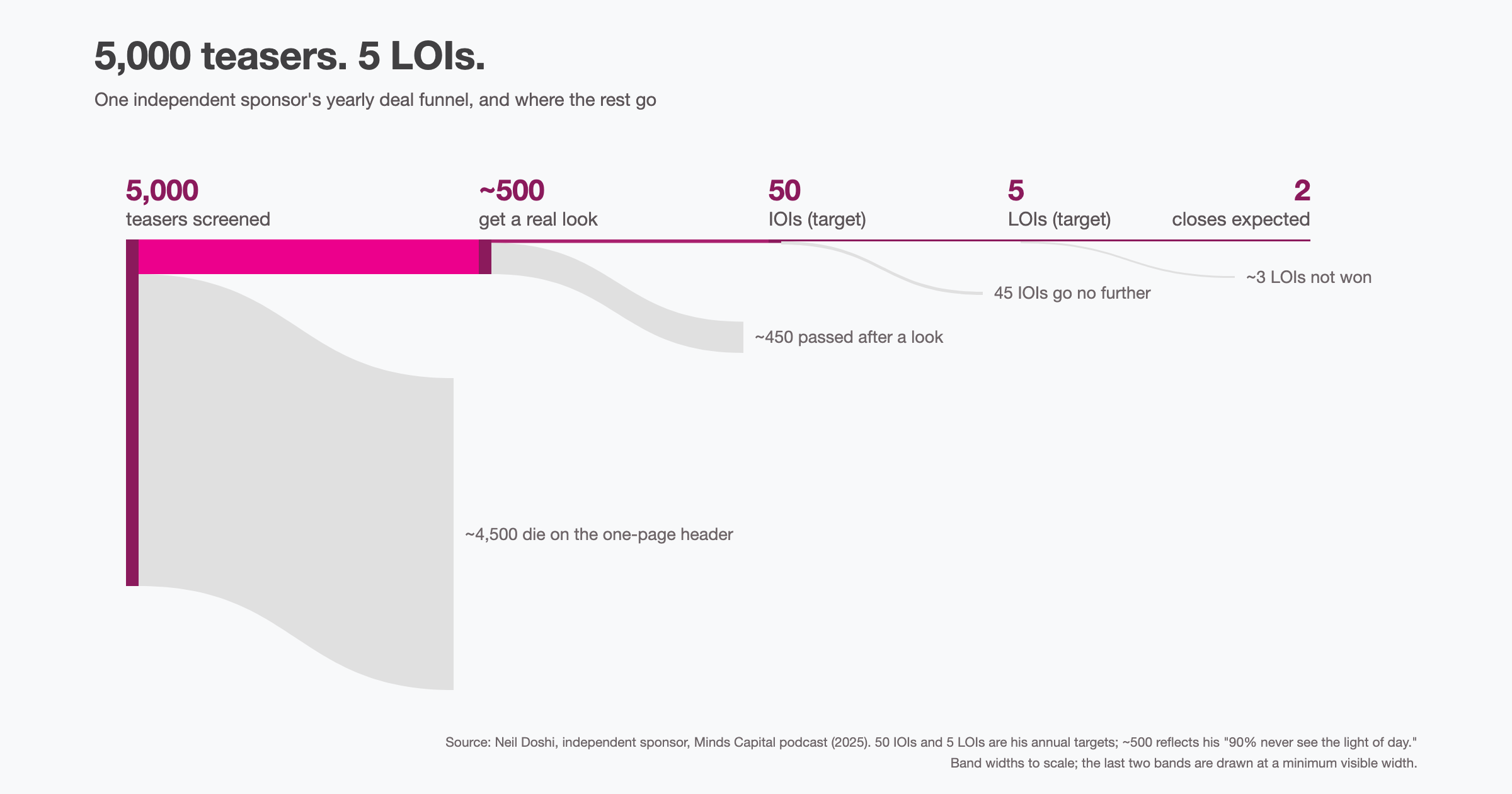
Ask most sponsors for their funnel math and you get a mood. Neil Doshi, an independent sponsor who screens roughly 5,000 deals a year with his partner, gives actual numbers:
“Of the 5,000, I’ll tell you that 90% never see the light of day… We try to target 50 IOIs and 5 LOIs per year. That’s generally the rule of thumb, 1%, 10%.”
Nine in ten teasers die on the one-page header, usually on size or sector, leaving about 500 that get real attention. He targets fifty IOIs and five LOIs a year and expects to win two. In 2024 the partnership fell short of both targets, which he put down to the quality of deal flow. Those IOI and LOI counts are the metric his partnership judges itself on every quarter.
His numbers fit his thesis, and yours will differ. What matters is that he has stage definitions, conversion rates, and a review cadence, and can state all three from memory.
Most sponsors could not do that for their own pipeline. They know they are busy. They know a few bankers send good stuff. The rest is inbox archaeology.
Why Sourcing Is Your First Analytics Problem
Before the first close, the deal pipeline is the only operating system in the building, and it decides whether there will ever be a building.
It is also where activity gets mistaken for results. Emails sent, conferences attended, bankers called, teasers downloaded: all activity. IOIs issued, LOIs signed, deals closed, and the conversion rates connecting them: results. A sponsor can be extraordinarily busy on the first list and blind on the second, and the inbox will never say which is happening.
The first-time sponsor starts with no track record, no process to inherit, and no idea what a normal IOI-to-LOI conversion looks like. So the default is more. More outreach, more lists, more coffees. Whether deal flow follows is unknowable, because nothing is measured.
A CRM full of contacts passes the existence test. It passes the utility test only once stage and source are logged against every teaser that enters it.
Measure Conversion by Channel: Two Engines
The sponsors with the steadiest deal flow run sourcing the way an operator runs a sales org: separate channels, each with its own yield. Edward Crawford, president and co-founder of Coltala Holdings, splits his firm’s into two. A branding engine, built on the firm’s newsletter and LinkedIn, and a relationship engine, “what we call our top 50 relationships.” By his count about 80% of deals come from the relationships, with the branding side adding reach.
The branding engine is a monthly newsletter with roughly 30,000 subscribers. Crawford said a single send has sometimes produced 14 or 15 deals inside 24 hours. A channel with a measurable yield per send.
The relationship engine is 50 people on a scheduled cadence of real meetings, and by Crawford’s account about 80% of those conversations are about kids and sports and what you are doing this weekend. “We want to get paid to hang out with our best friends,” Crawford said. It also keeps a relationship score on each of them, the number of deals that person has sent over seven years, which is why he can name the exact share of deals each relationship has produced.
That is channel attribution, and it needs one field on every teaser: where did this come from? Banker name, broker name, newsletter reply, LinkedIn inbound, a referral. A year of that field might show that the five bankers you have known for a decade produced most of your IOIs and the two conferences you attend every year produced none.
Source-level data also shows you the other side of the table. Know how many deals each source will send you in a year, and know its economics: a banker closing three deals this year has different math from a firm chasing ten platforms, and you only see it at the source level. Jay Jester, then a partner at Plexus Capital, pairs that with a rule for the marginal BD hour: go deeper with the sources that already trust you before starting a new relationship from scratch.
So the tiers most sponsors carry in their heads (the ten who would call you first, the fifty you see a few times a year, the few hundred who know your name) belong in the data model, with a source yield attached to each. Depth is measurable: last conversation, deals shown, deals advanced, deals closed.
Build the PE Deal Flow System: What to Track
All of this fits in a spreadsheet. What it needs is definitions and the discipline to log against them, or in Jester’s words, to “write it down and save it and categorize it and make it actionable so that you can rely on that data the next time you need it.”
The minimum data model:
Define the stages and write them down. Teaser received, passed screen, management conversation, IOI submitted, LOI signed, closed. The definitions are what make the numbers comparable: “passed screen” has to mean the same thing in March as in October, or the conversion rates are noise.
Write down the screen itself. Doshi’s team runs four quick checks on every teaser that survives the header: growth profile, margin profile, customer concentration, and what the seller is looking to do. That is a buy box in four lines. A screen that lives in your gut moves every time you are hungry for a deal, the same way an operator’s strike zone drifts when every initiative looks good.
Tag the source on every teaser. One field, filled every time. After a few quarters, channel conversion rates stop being guesses.
Track the relationship cadence. For your inner circle, log the date of the last real conversation, transactional or otherwise. A spreadsheet works at first. The question it answers: who sent me my best deal two years ago and has not heard from me this quarter?
Review stage conversion and source yield quarterly. Doshi’s partnership reviews quarterly because each quarter is a little different. Plenty of teasers and few IOIs points to a loose screen or a thesis the market is not serving. Plenty of IOIs and no LOIs points to pricing, or to the quality of the sources sending you deals.
An illustrative example, with made-up numbers: a first-year sponsor logs 1,200 teasers, 110 pass screen, 12 become IOIs, and one becomes an LOI that dies in diligence. Painful, but legible. The leak is at IOI-to-LOI, and the source tags show whether those 12 IOIs came from one broker running wide auctions or five relationships that each sent one. Two different fixes. Without the data, the same bad year.
Position for a Channel You Can Measure
Once source yield is visible, positioning becomes a data decision. Renaud Besançon, a European independent sponsor who ran an industrial group before investing, built his pipeline around a situation larger funds avoid. His firm presents itself to sell-side advisers as a service provider: “Whenever you have a failed auction, you call us. Whenever you have a primary situation that’s too complex for the traditional PE fund, you call us.”
The broken auction is a channel: a source (the sell-side bankers who ran the process), a trigger (the process failed), and a conversion rate you can track like any other. Besançon chose it because it fit his background and his capital, then told the market, and the channel sends him deals without a cold email.
The funnel does not end at the LOI either. Deals die between signature and close for reasons the screen never caught, usually on the seller’s side, and that pattern is predictable enough to screen for before you commit six months. Log why. Three broken LOIs with the same cause is a stage definition to tighten.
The Deal Flow Audit
I spent a year trying to buy a business. Full diligence. SBA loan. The seller backed out. But that year taught me more about how data really works inside a company than any consulting engagement before or since. The lesson starts before the close: the funnel that produced the LOI is the first dataset a sponsor ever owns, and most never look at it.
The audit takes an afternoon. List your ten most important deal relationships and, next to each, the date of your last non-transactional conversation. Then pull every teaser you have seen in the last twelve months, tag its source, and mark the furthest stage it reached. Count the IOIs and LOIs by source.
You will find relationships you have let go quiet, a source or two carrying most of your real pipeline, and at least one activity eating your week that has never produced an IOI.
That afternoon is the first iteration of Crawford’s two engines. Luck still matters in this business. The sponsors with consistent deal flow are engineering it: a defined screen, a tagged source, a cadence with the people who matter, and a quarterly look at the math.
Once the funnel produces an LOI, the next diligence runs on the capital provider who will fund it. Build the front of the pipeline first.
Sources: Minds Capital podcast (Neil Doshi, Edward Crawford and Renaud Besançon, 2025); Investors & Operators podcast (Jay Jester, 2021).
Alex Escoriaza helps independent sponsors and PE-backed companies turn messy data into operational clarity. If your pipeline lives in an inbox and a feeling, the audit above is a reasonable afternoon, with or without help. Want a second set of eyes on the data model? Send me the four tabs.