Why Roll-Up Integration Stalls at Six Platforms

Every roll-up pitch follows the same arc: buy a platform company, bolt on acquisitions, consolidate operations, grow EBITDA, arbitrage the multiple. Every LMM PE deck has some version of it. The math works on paper. The strategy makes sense in the investment committee.
Then you close the third deal and discover you’re paying for six different platforms that all do the same thing. Six logins. Six data formats. Six teams who all think their way is best. And every portco tells you their system is “deeply ingrained” in how they operate.
John Caple, who’s built his PE thesis around acquiring and integrating HVAC businesses, puts it simply: “Roll-ups are really easy to describe but much harder to execute.”
Welcome to the messy middle of roll-up execution.
What the Best Roll-Up Operators Do
Not every roll-up stalls on integration. The ones that don’t share a common trait: they treat platform consolidation as a core competency, not an afterthought.
Luis Reyes left McKinsey to run a fire safety roll-up. Over 30 acquisitions. Seven in a single month. Over $8M in EBITDA. That volume only works if you’ve built repeatable integration infrastructure before you need it. You can’t figure out your ERP migration strategy while you’re closing seven deals simultaneously.
Caple takes the same approach in HVAC. When asked what differentiates his platform, he doesn’t talk about deal sourcing or valuation discipline. He says: “What differentiates us is how well our acquisitions are integrated and how we treat our people.”
That’s a counterintuitive claim worth sitting with: you can integrate aggressively and still retain people. Decisive integration done with clear communication creates less anxiety than the slow, ambiguous alternative.
Why Platform Chaos Persists
If the solution is obvious, why do most roll-ups still struggle? Four reasons.
“Deeply ingrained” becomes an excuse. Every acquired team says their system is embedded in their workflows. Sometimes that’s true — data structures, integrations, and automations are built around a specific platform. More often, it means “we’re comfortable with what we know.” The distinction matters. One is a technical constraint. The other is emotional.
Deal teams don’t plan for integration. The investment memo covers the what and the why. It rarely covers the how. Integration planning starts after close, when it should start during diligence. By the time the ops team inherits the problem, the clock is already running. The value creation plan says “standardize operations” without specifying what that means, what it costs, or how long it takes when six teams all think their system is the right one. That gap between the investment memo and operational reality is where roll-ups stall.
Slow decisions compound the problem. Every week you delay the platform decision, parallel systems become more entrenched. People build workarounds. Those workarounds become the new normal. Six months into a delayed migration, you’re not fighting technical complexity. You’re fighting organizational inertia.
The cost stays invisible until it isn’t. Redundant licenses are easy to spot. The real cost is in salary-equivalent hours: the 15 hours a week your finance team spends stitching reports from five different systems. The manual reconciliation. The reporting gymnastics. None of it shows up on a line item. All of it compounds with every acquisition.
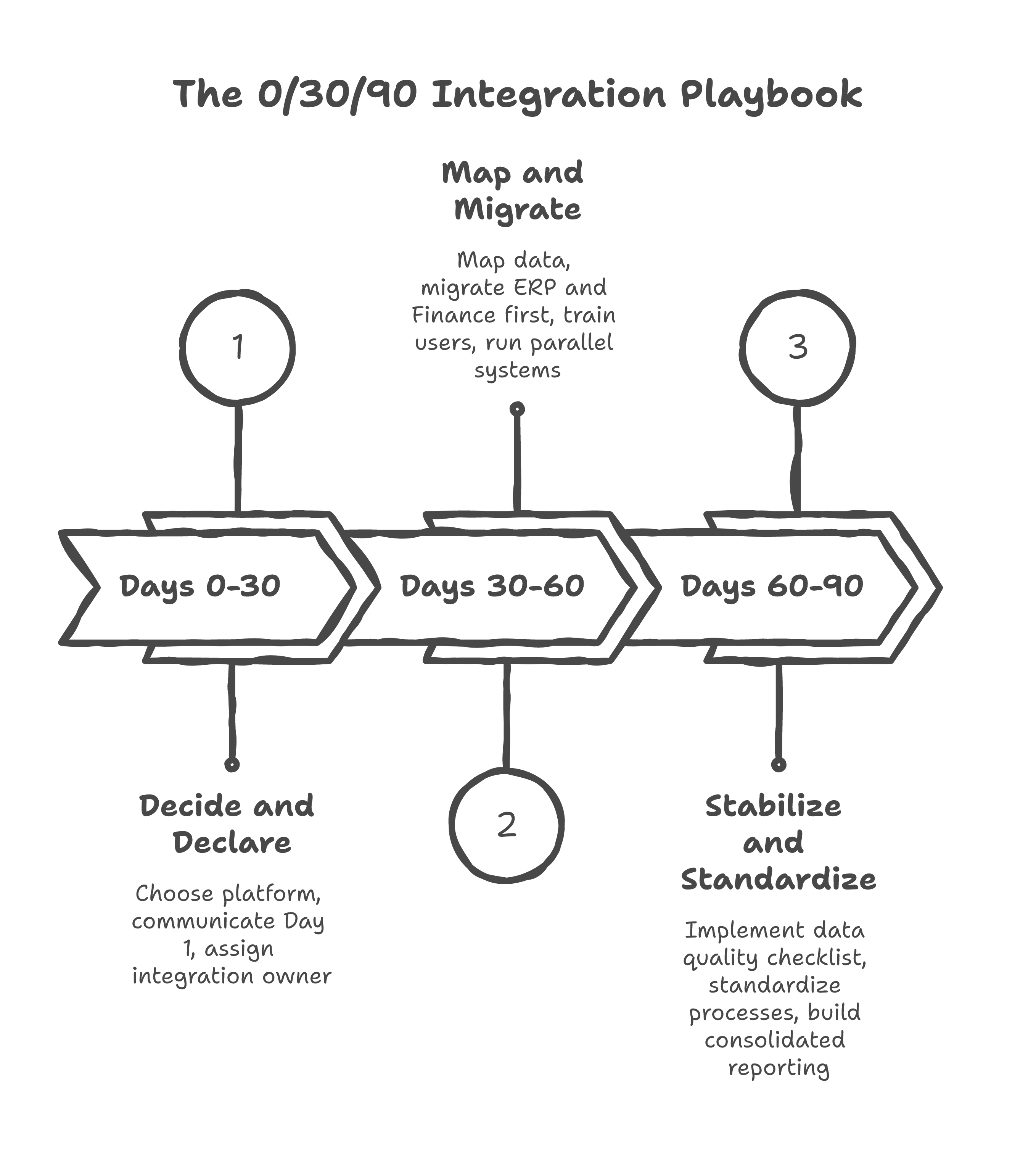
The 0/30/90 Day Integration Framework
The operators who get this right run a playbook. Here’s the framework that works — on paper. In practice, every step involves a conversation you’d rather not have and a deadline someone will push back on. But the structure is what keeps you moving.
Days 0-30: Decide and Declare
The platform decision happens before close or immediately after. Not in month three. Not after a “thorough evaluation process” that’s procrastination with a professional veneer.
Pick the platform. If you’re the platform company in a roll-up, the answer is usually your existing system. If you’re consolidating equals, pick the one with the best data structure and the most scalable architecture. Don’t pick based on which team will complain least.
Communicate the decision on Day 1. Not “we’re evaluating options.” The message is: “This is the platform. Here’s the timeline. Here’s who owns the migration.” No ambiguity.
Assign a single integration owner. Not a committee. One person whose job is to make this happen. They report on progress weekly. They have authority to make decisions without routing through three layers of approval.
Days 30-60: Map and Migrate
By week five, your integration owner should be mapping the target’s data structures to the destination platform. This is where the real gaps surface: field definitions that don’t match, historical data that doesn’t transfer cleanly, custom workflows that need rebuilding.
Prioritize financial visibility first. Non-negotiable. Consolidated financial reporting is the backbone of PE portfolio management. If you can’t produce a reliable consolidated P&L within 90 days of close, you’re flying blind — and every acquisition makes it worse. For roll-ups doing a handful of acquisitions, that means migrating to a single ERP. But if you’re closing 20+ deals a year across dozens of locations, forced migration at that velocity is a treadmill you’ll never get off. In that case, the faster path to visibility is a data layer that normalizes across your existing systems — get every location reporting into one view without ripping out what’s already working. You can always consolidate ERPs later. You can’t wait for consolidation to get visibility.
Run parallel systems for two weeks maximum. Not two months. Parallel running is a safety net, not a lifestyle. Every additional week of parallel operation doubles the back-office burden and halves the urgency to complete the migration.
Train relentlessly. The number one reason migrations fail isn’t technical. It’s adoption. People revert to what they know under pressure. Front-load the training. Make it hands-on. Give people a real task in the new system on day one of migration, not a webinar.
Days 60-90: Stabilize and Standardize
By day 60, the target company should be operating on the consolidated platform. Days 60 through 90 are about cleaning up and locking in.
Data quality becomes the focus. Migration always introduces errors — duplicate records, broken formulas, misclassified accounts. Build a data quality checklist and run it weekly for the first month post-migration.
Standardize processes across locations. Same chart of accounts. Same reporting cadence. Same KPI definitions. This is where you stop having six versions of “revenue” and start having one. It’s a definition problem, not a technology problem.
Build consolidated reporting. The whole point of platform consolidation is visibility. By day 90, you should produce a single report that benchmarks performance across every portfolio company on the same metrics, in the same format, from the same source.
The People Dimension
The framework above is mechanical. Necessary, but insufficient. The hardest part of integration isn’t the technology. It’s the people.
Scott Abbott, who’s been through multiple roll-up integrations, puts it directly: “The hardest part wasn’t capital — it was aligning how we think about control.”
That’s the emotional core of every platform migration. You’re telling a team that the system they built their workflows around is being replaced. For many of them, their proficiency in that system is part of their professional identity.
Name the fear. Don’t pretend the transition is easy. Acknowledge that change is uncomfortable. Then show the upside: less manual work, better reporting, more time for work that matters.
Set deadlines and hold them. Empathy doesn’t mean infinite patience. You can support people through a transition and still expect them to meet milestones. Extending timelines every time someone pushes back signals the migration is optional.
Accept some attrition. Not everyone will make the shift. That’s a cost of integration. But it’s a smaller cost than running parallel platforms indefinitely.
Justin Smith, who advises PE firms on integration strategy, adds an important nuance: “Integration fails when PE firms underestimate founder attachment.” The person who selected the original platform sees it as an extension of how they built the business. Replacing it feels personal. The best integration owners address this directly rather than treating resistance as irrational.
Aggressive integration and strong culture aren’t mutually exclusive. You don’t get both by being soft on timelines. You get it by being clear about the destination, honest about the difficulty, and invested in helping people get there.
The Real Cost of Waiting
Every month you delay, the problem compounds. More data in disparate systems. More workarounds. More comfort with the status quo. The migration that would have taken 60 days after close takes six months a year later.
Everyone has a roll-up thesis. The question is whether you can actually see what you’ve bought across all of them. If you’re three acquisitions in and still running parallel platforms, the window for easy consolidation is closing. Every deal you close without a migration playbook makes the next integration harder. Put a number on what the parallel platforms are costing you.
Alex Escoriaza helps PE-backed companies turn platform chaos into operational clarity. If you’re navigating roll-up integration and need a system that scales with each acquisition, reach out.