

A former private equity investor announced he was leaving the industry to go run an HVAC business.
Not to invest in HVAC. To operate one. To wake up worrying about technician schedules, service margins, and whether the phones get answered.
The replies to a moment like that tell you more about where PE returns are going than any fund letter will. The smartest people in the room are no longer arguing about capital structures. They’re arguing about who can actually run the business they bought.
That argument is the whole story of the next decade.
The Model That Made Operating Optional
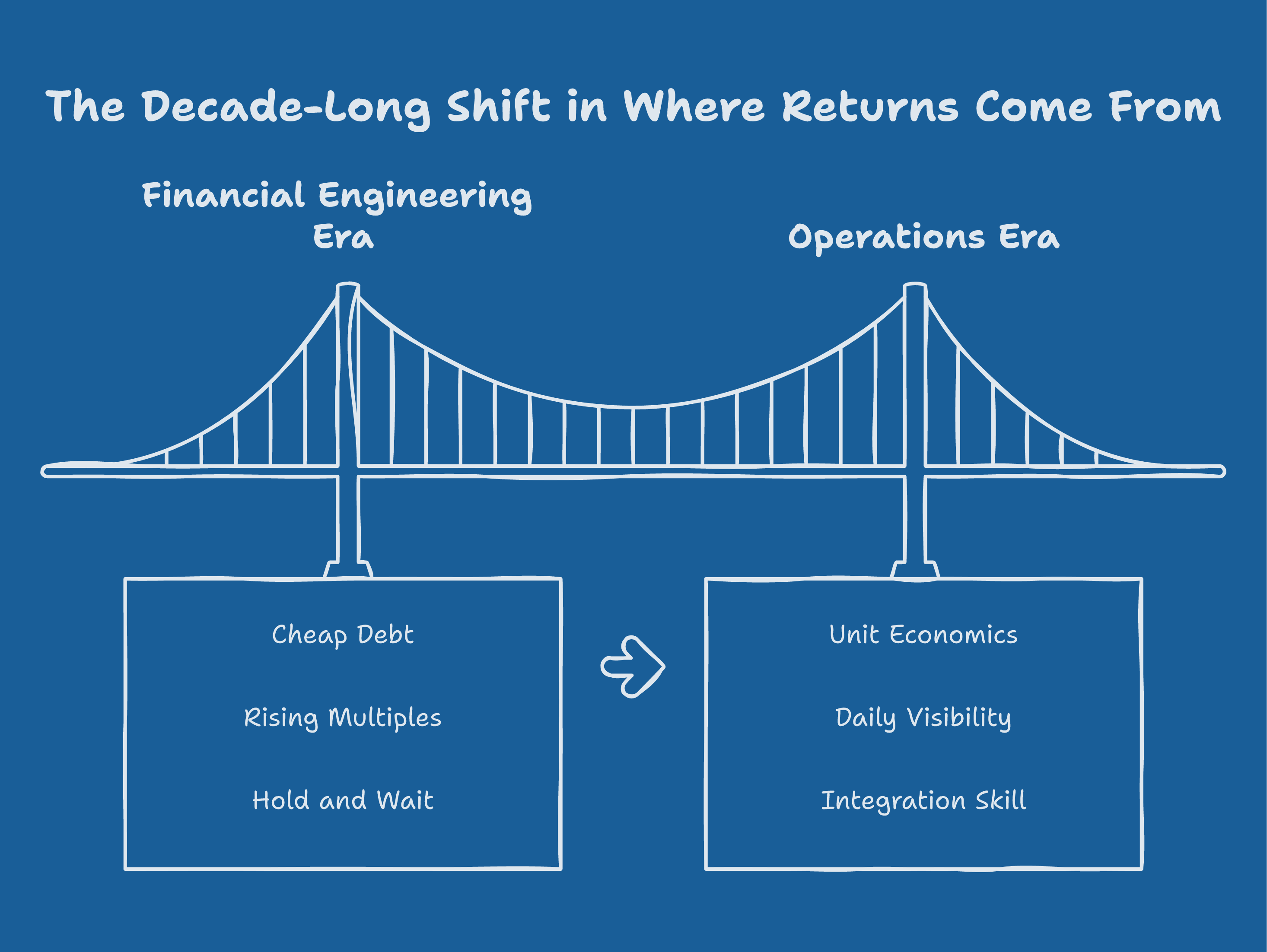
For most of the last fifteen years, you didn’t have to be good at operations to make good money in private equity.
You had to be good at three things: buying at a reasonable multiple, borrowing against the asset, and waiting. Cheap debt did a lot of the lifting. Multiples drifted up almost regardless of what you did inside the company. You could install some reporting, swap in a CFO, and let the cycle carry you to an exit at a higher number than you paid.
That wasn’t fraud. It was rational. When the leverage on the way in and the multiple on the way out are doing most of the work, why build an expensive muscle for operating businesses you’re only going to hold for four years? The math behind that era, and why it’s over, is a post of its own. The short version: every input flipped. Cost of leverage is a multiple of what it was. Exit multiples are flat or drifting down instead of up. And more capital is chasing fewer clean deals, which pushes entry prices higher — the exact opposite of what you want when the plan is to buy cheap and improve.
Strip those tailwinds away and you’re left with the one return driver nobody can fake: growing the EBITDA of the actual business. The gap between what the model promised and what the company can produce shows up fast once the market stops bailing you out. The market has stopped.
The Tell Is Where the Operators Are Going
You can debate the macro all day. What’s harder to argue with is where practitioners are voting with their careers.
The investor headed for HVAC wasn’t a fringe voice. Will Schryver, a longtime allocator, has been blunt about the math that’s changing the game: “Private equity MOIC is highest when the entry EV/EBITDA is less than 6x.” That number sounds like a win, and it is — but read the second half. Businesses selling under six times EBITDA aren’t clean compounders. They’re businesses that need work. Messy revenue. Owner-dependent operations. Reporting held together with a spreadsheet and someone’s memory.
Which is exactly why he’s trading the deal seat for the operating one. When the return lives in the operating improvement, the improving is the job. You can’t do it from a data room.
Look one reply down and you find operators who never left the operating chair, and who understand the new math viscerally. “I closed on my first small business acquisition in late 2022. I hate having debt,” one buyer wrote flatly. That’s not a sophisticated thesis. It’s survival instinct. In the old model, leverage was the accelerator. In this one, it’s the thing that kills you when the operating improvement takes longer than the plan assumed. It always takes longer than the plan assumed.
The operators who make it through the next few years are the ones who aren’t betting the company on a refinancing that may never come at a rate they can afford.
The Lever Everyone Names and Almost Nobody Pulls
Here’s where it gets uncomfortable for firms that have spent a decade calling themselves operational.
Multiple arbitrage is the lever every strategy deck names. Buy a platform, bolt on cheaper businesses, sell the combined entity at the platform multiple. The math is a five-minute conversation, which is exactly why everyone has the same slide.
The execution is a five-year knife fight, because the arbitrage only pays if you integrate what you buy.
Integration is where the value creation plan either becomes real or becomes a slide nobody looks at again. Two sets of systems. Two chart-of-accounts logics. Two ways of counting a “customer.” One business measures margin by job and the other by month, and now you own both and can’t answer a simple question — which service line makes money — without a three-week fire drill.
There’s a second trap under the first. A lot of these deals were priced for steady financial engineering, then loaded with growth expectations that require genuine operating transformation: venture-grade execution risk bolted onto a leveraged capital structure. The capital structure says “safe compounding.” The value creation plan says “reinvent the business.” Those don’t reconcile. Something has to give, and it’s usually the management team’s sanity somewhere around month nine.
What This Looks Like From the Operator’s Chair
Strip the macro away and here’s the shift in plain terms. Four things change for anyone running the play.
You have to know which cash flows are worth improving before you commit to improving them. Not all revenue is created equal, and consolidated EBITDA hides that. A recurring service contract and a one-time project can carry the same margin on a spreadsheet and be worth completely different multiples in reality. If your only view is the consolidated P&L, you’re flying blind on the exact question the new model rewards. That’s why the unit-level economics have to be visible before you can act on them, not discovered after.
Financial reporting stops being enough on Day 1. The old model only needed the numbers to be real. The new one needs to know if they’re getting better — this month, in this location, on this crew. That’s an operational question, and the financial statements won’t answer it. Month four post-close, you should be able to say whether the value creation plan is working. Plenty of operators can’t, because nobody built the visibility to see it. We’ve covered how a portfolio team loses the plot without that layer: same root cause, earlier in the timeline. The CEO who never leaves the office is stuck in the spreadsheet for the same reason — the operational data infrastructure doesn’t exist yet.
Integration becomes a core skill, not a workstream you outsource. If your return comes from combining businesses, the ability to merge how they operate, not just consolidate their financials, is the whole game. Financial consolidation gets you a clean report. It does not get you a business that runs as one.
Capital discipline becomes a feature, not a limitation. The operators quietly winning right now are frequently the ones who used less leverage, not more — because it bought them time to do the operating work without a debt clock running down behind them.
Merging the data model and the business model isn’t a nice-to-have in this world. It’s the difference between knowing whether your plan is working and hoping it is.
The Contrarian Voice, and Why It Lands
Not everyone in those replies was buying the “PE will save you with operational excellence” story. One operator put it with a dry edge: management teams, the argument goes, “don’t really want that discipline,” and we’re all so lucky PE exists to install it.
The sarcasm is doing real work. It names the gap between the operational expertise a lot of firms claim and what they’ve historically done, which is improve a capital structure and call it value creation. For a decade the market covered for the gap.
It doesn’t anymore. This isn’t an anti-PE argument. It’s a pro-operations one. The firms that win the next ten years aren’t the ones with the best-sounding decks about value creation. They’re the ones that can do the work — see the business at the unit level, know which cash flows matter, and merge two companies into one that runs better than either did alone.
The Question Underneath All of It
This migration isn’t really about interest rates. It’s about a skill the industry could avoid building for fifteen years and now can’t.
When your return came from leverage and rising multiples, you could buy a business you didn’t fully understand and still do fine. When your return comes from operating that business better, the understanding is the return. You can’t improve what you can’t see, and you can’t see it from a financial model. That’s why the analytics roadmap is now a core piece of the value creation plan, not a nice-to-have.
So the question every firm and every operator is quietly asking right now is a simple one: when the value creation plan says “grow EBITDA through operations,” do you have the visibility to know if it’s working — or are you bringing a spreadsheet to an operations fight?
Most people know their honest answer. The ones who like it are the ones who started building the operating view before they needed it.
Alex Escoriaza helps PE-backed companies turn messy operations into the kind of visibility the new return model actually requires: seeing the business at the unit level, before and after the transaction. If operational improvement is now the thesis and you’re not sure you can see whether it’s working, let’s talk.