AI Is a Tactic, Not a Strategy: Why PE Portcos Get Stuck in Pilot Purgatory

Here’s a pattern I see playing out across PE portfolios right now. The board asks management to “build an AI strategy.” Management tasks IT with standing up an AI pilot. IT deploys two or three tools. The team runs a few experiments, generates some enthusiasm, and produces a slide deck. The board deck next quarter has an AI update.
Nothing measurably changes.
The pilot is still running six months later. Or it’s been replaced by a different pilot. There are now five tools in the stack with partial adoption and no clear owner. Someone is paying for three subscriptions that overlap in function. And when the board asks what the AI initiative has returned, the honest answer is: nobody’s measured it.
This is pilot purgatory. It’s not a technology problem. It’s a definition problem.
The Pressure Creates the Trap
AI has become a box PE boards expect to check. That’s not entirely irrational — the competitive pressure is real, the cost of falling behind is real, and the downside of appearing asleep at the wheel is real. But “build an AI strategy” without operational specificity is roughly as useful as “grow revenue.”
The result is a particular kind of busyness. Portco management teams launch experiments because launching experiments is visible. The problem is that experiments without defined success criteria are just activities. And activities without outcomes are noise.
Bob Morse, co-founder of Strattam Capital, draws the line cleanly: “Invention means I can do it. Innovation is, I have a business model around it.”
That distinction matters here. Deploying an AI tool is invention. Deploying an AI tool that solves a specific problem at a measurable cost-per-outcome — that’s innovation. Most portcos are stuck at invention and calling it strategy.
What Pilot Purgatory Actually Looks Like
The specific mechanics vary by company, but the shape is consistent. A portco announces an AI initiative. Early adopters self-select. Early adopters are, by definition, the people most predisposed to the technology — which means results skew optimistic and won’t reflect how the broader organization actually uses the tool.
The pilot reports look good. The board hears about AI. The initiative spreads to teams that weren’t involved in the pilot and weren’t set up for success. Adoption drops. The tool sits installed and unused. Existence, as it turns out, does not equal utility.
Doug McCormick at HCI Equity Partners describes the timeline mismatch that makes this worse: clean, AI-ready data takes years to build, but board pressure to show AI progress is now. Companies are being pushed to deploy AI tools on top of data infrastructure that isn’t ready to support them — which guarantees underperformance and deepens skepticism about whether AI works at all.
If your portco’s data isn’t organized yet, that’s the actual starting point. I wrote about why data organization has to come before AI strategy — and the argument there is harder and more important than anything in this post. Start there. This post assumes you’ve cleared that hurdle.
The Firms Getting Real Returns
It’s worth being clear that AI genuinely works when deployed against a specific problem. The returns aren’t hypothetical — we’ve covered what this looks like in practice: 500% productivity gains for under $50/month. Not from an AI strategy. From identifying exactly where human time was being burned and replacing it with a targeted application.
That arithmetic holds regardless of company size or sector. The firms generating real returns didn’t start with AI strategy. They started with a specific operational problem. And the distinction between AI that compounds and AI that piles up comes down to whether that problem was named before the tool was picked.
The Three Questions That End Pilot Purgatory
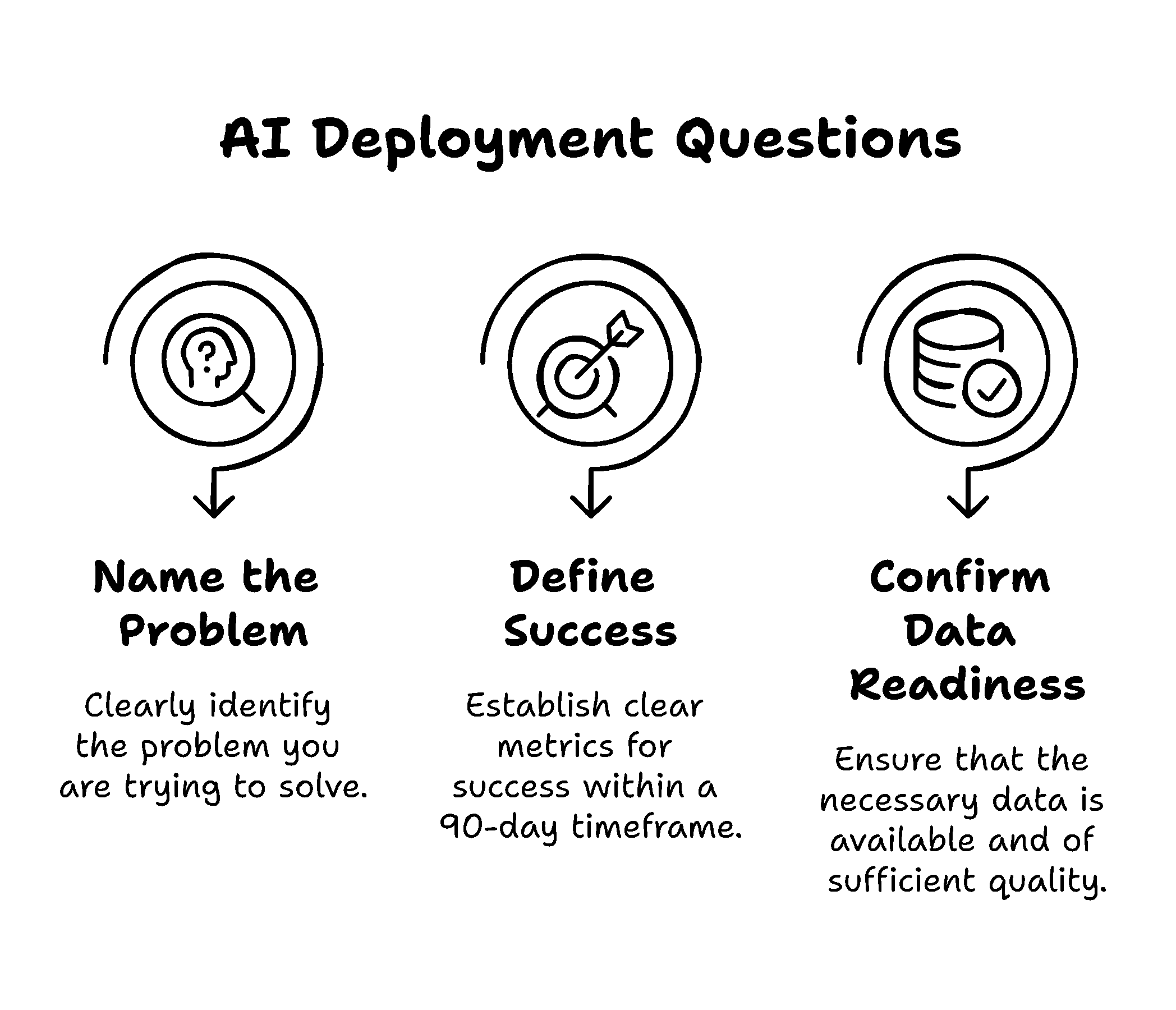
Before any AI deployment, three questions need answers. Not aspirational answers — operational ones.
These questions will seem obvious. Most operators I talk to say they asked them. What they usually mean is: the answers were assumed, not tested. That gap is where pilots die.
First: What specific problem are you solving?
Not “improve efficiency.” Not “enhance customer experience.” A specific problem: the outbound prospecting team is manually composing 200 emails a week and converting at 1.2%. Or the finance team is spending 40 hours a month pulling together data for a report that nobody acts on.
If you can’t name the problem in one sentence, you’re not ready to pick a tool.
Second: What does success look like in 90 days?
Not directionally better. A number. Prospecting emails take 20 minutes instead of 4 hours. Report production drops from 40 hours to 6. Conversion rate moves from 1.2% to 1.8%.
The 90-day window matters. Short enough to keep the experiment honest, long enough to see whether the tool actually changes behavior — not just gets used in week one.
Third: What data do you need, and do you have it?
This is where most pilots fail silently. The tool might be excellent. The problem might be real. But if the underlying data isn’t structured in a way the tool can use — if the CRM is inconsistent, if the financial reporting is manual, if the pipeline data lives in three different formats across five platforms — the tool will underperform and the failure will be attributed to AI when the actual failure is infrastructure.
Where AI Actually Delivers in PE Portcos
When those three questions have answers, a handful of use cases produce consistent returns across the portfolio.
Darren Herman at Bain Capital has tracked prospecting email performance carefully: “I have yet to see a human written prospecting email perform better than a gen AI written prospecting email.” Outbound prospecting is the clearest, most measurable AI win in sales-intensive portcos — volume goes up, output quality improves, and the conversion data shows it.
Content and synthesis work — summarizing reports, drafting investor updates, distilling long call transcripts — is the Mooney 500% territory. The tasks are repetitive, time-intensive, and the quality bar is achievable. Not glamorous. But these are the use cases that actually save 10-20 hours per month per person.
Data pattern recognition at scale — flagging anomalies in financial performance, surfacing unusual trends across portfolio companies, identifying operational deviations before they compound — is where AI moves from productivity tool to strategic asset. But this requires clean, structured data as a prerequisite. Which brings you back to question three.
What ties all of these together: each is a response to a specific, named problem. Not “AI strategy.” A problem.
The Change Management Layer Nobody Budgets For
Here’s what happens after you pick the right tool for the right problem and deploy it on good data. Most of your team doesn’t use it.
Conor Grennan, who studies organizational AI adoption at NYU Stern, names the gap precisely: “The learning is easy, the practice is hard.”
The learning is a training session, a tutorial, a vendor onboarding call. It takes an afternoon. People leave feeling capable. Then they return to the actual pressure of the job — deadlines, client calls, board requests — and revert to the tools they already know. The new tool sits in the browser tab they never open.
This is not a technology failure. It’s a behavior change problem. And behavior change requires a different kind of investment than tool deployment: managers who model the new behavior, workflows that integrate the tool by default rather than by choice, performance metrics that make adoption visible.
The firms that compound AI returns treat it like any other operational change — they figure out what “good” looks like before rolling out to the organization, they build accountability structures around adoption, and they measure whether behavior actually changed. The ones stuck in purgatory treat it like a software rollout: deploy, announce, hope.
Technology amplifies what’s already working operationally. It doesn’t substitute for the operational foundation that needs to exist first — which is the same reason technology fear is a change management problem before it’s a tool problem. The firms that compound AI returns treat adoption the way they treat any other operational change: accountability structures, behavior metrics, managers who model the new workflow.
The Stakes
The risk of pilot purgatory isn’t just wasted software spend. It’s that twelve to eighteen months of low-quality experimentation depletes leadership bandwidth, generates organizational cynicism about AI, and leaves the company behind competitors who were more disciplined about where they started.
The firms that build real AI capability in the next two years will be the ones that asked hard questions before deploying anything. They will have a shorter list of tools, clearer ROI, and more actual adoption. The firms that ran pilots will have a longer list of half-adopted subscriptions and a harder time explaining what they have to show for it.
Figuring out what “good” looks like before you measure it is the discipline that separates the two groups — and it applies just as much to AI adoption as it does to any other operational improvement initiative.
If your portfolio company is in the middle of an AI initiative and you’re not sure whether it qualifies as a strategy or a collection of experiments — ask yourself whether you can answer those three questions. If you can’t, reach out. Happy to think through it.