Cash vs Accrual Revenue: Why Your Fastest KPI Lies
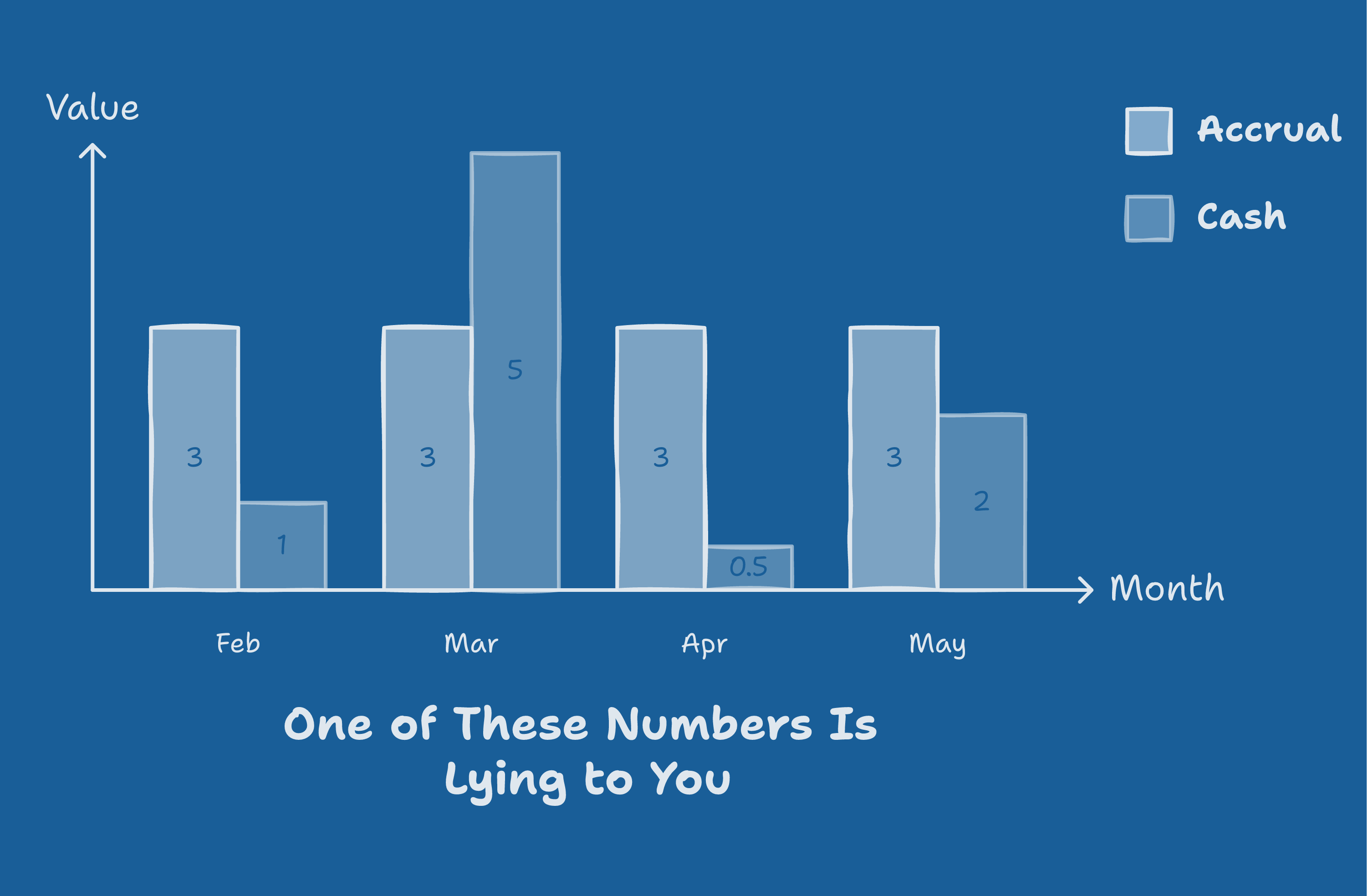
Imagine a leadership team celebrating a month that didn’t happen.
Picture a seasonal, multi-location service business, a few acquisitions into a roll-up. The monthly number comes in dramatically up over the same month last year. The energy in the review is exactly what you’d expect. Something is working.
Nothing is working. Nothing is broken, either. A major seasonal event got scheduled a few weeks earlier than the prior year, so the prepayments for it land in an earlier month. Same total dollars. Same real performance. The cash just crosses a period boundary, and the boundary does the rest.
The next month quietly gives it all back.
This happens constantly, in businesses that look nothing alike. Nobody in that room is being careless. The number is real money in a real bank account, and the first time you see a swing like that, almost anyone celebrates it. That instinct isn’t a flaw. It’s just human. But the swing is 100% timing and 0% performance. The month wasn’t great. It was early.
The Number Everyone Pulls
Cash collected becomes the default KPI in operating businesses for one reason: it’s fast.
It comes straight off a transaction search. One line item, one click. Every location produces it the same way. It updates daily, requires no judgment and no accounting close, and when you put it on a dashboard it never argues back.
Here’s the uncomfortable part. In situations like this, the cash report usually shows up with a caveat attached, almost apologetically, by the person who produced it. They call it a directional proxy. Not a very good one.
Sit with that for a second. The people producing the number already know it’s unreliable. It doesn’t get reported because anyone trusts it. It gets reported because it’s available. In most operating reviews, speed beats truth by default, and nobody decided that on purpose.
How Seasonal Revenue Timing Fakes a Performance Swing
The mechanics matter, because once you see them you can’t unsee them.
In a prepaid business, customers pay ahead of the thing they’re paying for. Deposits for an event. Registration fees for a season. Money arrives weeks or months before the service is delivered. Cash collected records the moment the money lands, which has nothing to do with the period the revenue belongs to.
Now put a period boundary in the middle. An event shifts a few weeks on the calendar. Registration opens earlier this year. A location runs a payment push in the last week of the month instead of the first week of the next. In every case, cash accelerates into one period and drains out of another. The reporting says one month surged and the next one slumped.
The KPI moved. The business didn’t.
That’s the cash-revenue mirage, and the danger isn’t the number itself. It’s what people do about it. Operators credit the fake great month to whatever initiative launched recently, and now a decision is anchored to noise. They react to the fake bad month by tinkering with pricing or staffing to fix a problem that doesn’t exist. Either way, you’re steering by a mirage.
I’ve written before about the post-close version of this problem, where operators can’t get at the operational numbers they need at all. This is the sneakier cousin. You can get this number instantly. It just answers a different question than the one you’re asking.
The True Number Nobody Can Pull
The honest number is accrual revenue: revenue recognized when it’s earned, not when it’s collected. A deposit isn’t revenue yet. It’s a liability. You owe the customer an event, a season, a service, and it becomes revenue only when you deliver. That’s the entire point of deferred revenue recognition. It ties the number to performance instead of to the calendar.
So why isn’t that the number on the dashboard?
Because at this company, and at most companies like it, nobody can pull it. Producing the accrual view meant manually peeling prepaid amounts out of the cash total, figuring out which event and which period each one belonged to, and releasing it on a schedule. Location by location. Every month. A recurring archaeology dig, performed by hand, to reconstruct what the business actually earned.
And the root cause sat one layer deeper. Prepaid deposits were entering the system coded to a generic name, no event and no date attached. The system couldn’t classify when the revenue should be recognized because nobody had ever captured the one piece of information that classification requires.
That’s not a software failure. ERPs are made for operating, not reporting. The transaction system did its job perfectly: it took the money, issued the receipt, updated the balance. It never asked “which period does this belong to?” because operations never needed the answer. Reporting does. The gap between those two needs is where the true number goes to die. A mapping decision nobody made at the point of data entry surfaces months later as a reporting problem.
The Easy Number Drives Out the True One
There’s a Gresham’s law of metrics: whatever you can pull in one click becomes the number in the meeting.
Not the best number. Not the number finance trusts. The available one. And the meeting number has gravity. It becomes the board number, then the forecast baseline, then the target on somebody’s comp plan. I’ve covered how the numbers leadership tracks cascade down into what every team optimizes — which is exactly why the choice of headline metric is not a reporting detail. If the headline metric is a timing artifact, the whole cascade inherits the distortion.
The stakes compound from there. Forecast off cash in a seasonal business and you’re building next year’s plan on this year’s calendar quirks. Compare year-over-year months and a scheduling change reads as growth or decline that never occurred. And when a board — or eventually a buyer — looks at monthly cash swings without an accrual view, they see a volatile, unpredictable business where a steady one exists. You pay for that misread twice: in the credibility of your reporting today, and in the multiple someone applies to your “volatility” later.
Make the Honest Number as Fast as the Misleading One
The fix is not “try harder at month-end.” Manual heroics are how the company got here.
The fix is to make the true number as cheap to pull as the misleading one. Two moves, in order:
Encode the recognition rules into the data layer. The logic finance applies by hand every month — this deposit belongs to that event, that event happens in this period, release the revenue then — is a set of rules. Rules can be built into the reporting layer once, so deferred revenue separates from earned revenue automatically instead of through monthly reconstruction.
Close the gap at the point of entry. The classification was manual because the source data was missing one field’s worth of information. Capture which event and which date a prepayment belongs to at the moment it enters the system — a required field, a mapping table, a small change to how front-line staff record a deposit — and the archaeology dig disappears. This is an operations change, not a finance change, which is precisely why finance alone could never fix it.
This is also why the early post-close window matters so much. The window right after close is when the management system gets set, and deciding which numbers the operating cadence will run on belongs in it, before the easy number entrenches itself in every meeting and every board deck.
The principle underneath both moves: the fastest KPI should also be the honest one. That’s an engineering choice, not an accounting inevitability.
Some of Your Best Months Are Illusions
If your headline growth number is cash collected and your business is seasonal or prepaid, some of your best months didn’t happen. Some of your worst months didn’t either. You’re reading the calendar and calling it performance.
One test: if your biggest event moved three weeks next year, would your dashboard call it growth? If the answer is yes, your fastest KPI is lying to you. And it will keep lying right up until a board meeting or a sale process where the truth gets expensive.
If pulling your true revenue takes a week of manual work while pulling cash takes one click, that gap is worth a conversation. Let’s talk.
Alex Escoriaza helps PE-backed companies build reporting where the number you can pull instantly is also the number that’s true — recognition logic in the data layer, not a monthly spreadsheet ritual. If your cash number and your real revenue tell different stories, let’s talk.