

The deal closed on a Friday. On Monday, the lawyers went home. The bankers sent their final invoices. And the real work — the work the financial model assumed would happen — had to start.
Everything in the model looked right. The EBITDA was there. The growth rate was there. The multiple was supportable. And in the weeks after close, the new owner and the management team were, by every visible measure, aligned. They had a hundred-day plan. They’d talked about priorities. There was energy and goodwill.
Six months later, the board was asking questions the management team couldn’t answer cleanly. Decisions were slow. Middle managers were waiting for approval on things they should have owned. The CEO was a bottleneck on half the organization’s work.
This is not a bad company story. It’s the pattern that plays out when deal assumptions and operational reality diverge — when the management structures needed to execute the plan never get properly installed.
The 80% Problem Nobody Talks About in Diligence
Jared Greer, Director of Portfolio Operations at QHP Capital, frames it bluntly: “Day 1 priorities: Who owns what decision? What metrics matter? How do we communicate? 80% of value destruction in year 1 comes from lack of this clarity.” These are the questions that determine whether Day 1 momentum carries forward or stalls.
Three questions. Most portco teams can’t fully answer them by month three.
This isn’t a failure of talent or effort. It’s a sequencing failure. The deal closes, everyone scrambles to demonstrate momentum, and the foundational infrastructure — the structures that let an organization make decisions and measure outcomes without everything flowing through the CEO — never gets properly installed. The first 90 days become reactive. By month six, reactive is the operating mode.
Scott Abbott, CEO of Five Star Franchising, knows what this looks like from the inside: “For a portco CEO post-close, if you don’t establish decision rights and clarity in week 1, you’re fighting for 18 months.”
Eighteen months. In a five-year hold, that’s 30% of your value creation timeline spent in friction that was preventable.
Why Founders Resist (and Why That Resistance Is the Problem)
Here’s the version of this story that plays out at founder-led businesses specifically. The founder has run this company for twelve years. He knows every function. He can answer any question faster than a decision rights matrix ever could. Structure feels slow. Bureaucracy feels like loss of control.
John Fruehwirth, Managing Partner at Rotunda Capital, names the pattern precisely: “Founders avoid defining roles, fearing loss of control. Result: everyone waits for approval on trivial decisions.”
The irony is exact. The founder avoids structure to stay in control and ends up as the single point of failure for every decision in the building. Growth stalls not because the strategy is wrong — but because the mechanism for executing it was never installed. Whether they can absorb the change depends on coachability as much as capability.
We’ve written before about how the founder-to-PE transition breaks down at the systems level. The operating partner’s job post-close is to install the system before the breakdown pattern sets in — and that includes earning the trust of a team that didn’t choose the new owner.
The Week-One Sprint
QHP Capital’s approach is specific and repeatable. The model: take the portco offsite for an entire week right after close: implement the management system, define roles, lock in metrics. One concentrated week designed to compress what most portcos spend six months figuring out, if they get there at all.
An entire week. Offsite. Right after close. That sounds expensive. It is — and everyone’s exhausted post-close. The lawyers just went home. The management team wants to decompress. The discipline is installing the system before the adrenaline fades.
Here’s what happens each day.
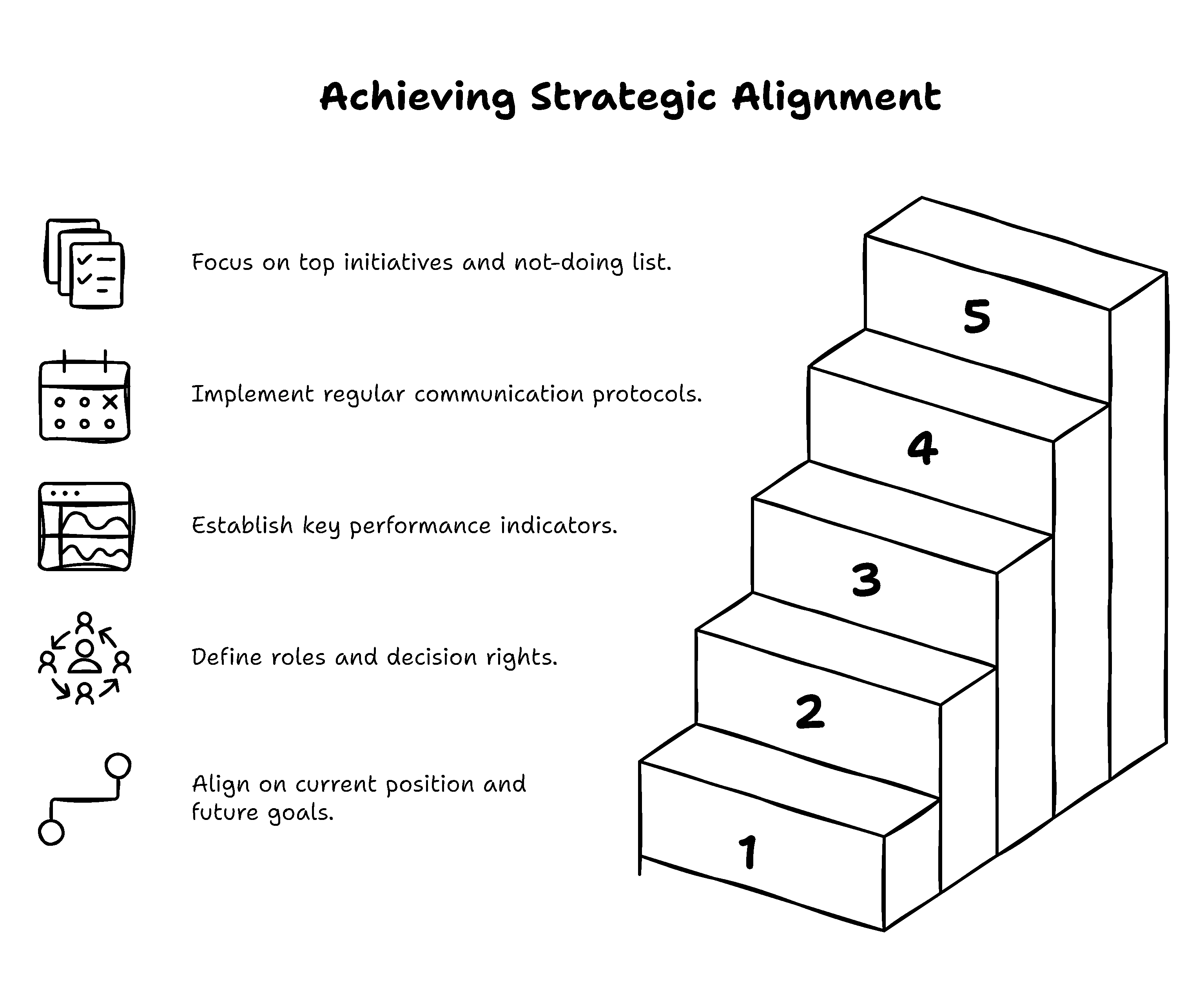
Step 1: Strategic Alignment — The From-To Chart
Before anything else gets defined, leadership has to agree on the destination. Vern Davenport, Partner at QHP Capital: “Everything starts with the from-to chart: where you are today vs. where you want to be in five years. Everything else is operationalization of that vision.”
The from-to chart isn’t a vision statement. It’s a before-and-after description of the business — current state across every major dimension (revenue, customer mix, operational maturity, team structure) versus target state at exit. It gets built by the CEO and the leadership team together, in a room, without interruption. This is “True North.” Everything downstream — which metrics matter, who owns what function, what the 90-day priorities are — derives from it.
Step 1 ends with the from-to chart locked. Not draft. Locked.
Step 2: Role Clarity — Functional Construct and Decision Rights
This is the day most portcos skip, and it’s the day that causes 80% of the problems Greer cited.
QHP’s approach: map the work first, not the people. What functions exist? What activities belong to each? Once the work is mapped, decision rights get assigned to those functions, not to titles, relationships, or whoever’s most accessible.
Each function gets a decision rights framework: what can it decide without escalation? What requires CEO sign-off? That CEO-level list should be very short. Then it gets published and enforced. “Check the decision rights matrix before Slacking me” is the target state.
Without that empowerment, the bottleneck forms fast. Every question flows to the CEO, and the organization can’t move faster than one person’s calendar. Middle management isn’t a bureaucratic layer. In PE-backed businesses, it’s the actual execution engine.
Step 3: Metrics Lock-In — The Tracking Sheet System
Day 3 is where most analytics conversations begin. QHP starts there only after two steps of strategic and structural clarity. The sequence is intentional: you can’t build the right tracking sheet until you know where you’re going (Day 1) and who owns what (Day 2).
QHP’s rule for metrics: 10 or fewer per function. Each is either a leading indicator (predictive) or lagging indicator (outcome). Status is binary: red or green. If it’s red, fix it. If it’s green, you’re on plan.
In practice, 3–5 per function is a more realistic starting point in year one. The ceiling is 10, not the floor.
Year 1 target: 43% green. Year 5 target: 80%+ green. The first year isn’t supposed to be clean — it’s supposed to surface the gaps so you can fix them.
This is what we mean when we say the goal is figuring out what good looks like before you start measuring everything. Red on the tracking sheet isn’t a crisis. Red without an owner and a fix is.
Step 4: Communication Cadence
This is the day that makes everything else stick — or not.
The weekly leadership meeting format gets defined: who’s in the room, what gets reviewed, how long it runs. The monthly board reporting structure gets aligned. Escalation protocols get set: when does a metric gap get flagged, to whom, and with what information attached.
QHP uses A3 problem-solving for escalations: one page with the metric gap, root cause analysis, action plan, owner, and timeline. When something goes red, the response format is already known. No debate about how to structure the problem, just the problem itself.
Step 4 doesn’t add meetings. It eliminates ad hoc escalations.
Step 5: 90-Day Priorities
Step 5 is the shortest in principle and the hardest in practice. The team identifies the top three initiatives that move the needle in the next 90 days. Each gets an owner, a timeline, and a success metric.
The second list matters as much as the first: what are you explicitly not doing?
Most portcos post-close have fifteen ideas. Trying to execute fifteen in the first 90 days means completing zero of them. The 90-day priorities exercise forces the trade-off. When someone proposes a new initiative in month two, the question isn’t “is this a good idea?” It’s “does it replace something on the list, or is it number sixteen?”
From Reactive to Predictive
The payoff from this sprint isn’t visible at the end of week one. It shows up six months in.
Greg Mayer, Head of Portfolio Operations at Argosy, describes the outcome: “Most portco leaders are reactive. Systems thinking lets you predict 90 days out instead of fighting fires today.”
The 90-day visibility that QHP’s system creates — through the from-to chart, the decision rights structure, the tracking sheets, the cadence — means the operating partner and the CEO can see problems before they become crises. Red on a tracking sheet in month two is a conversation. Red that surfaces in the board deck in month six is a credibility problem.
Michael Curry, Co-CEO at Lullwater, puts the counterintuitive truth cleanly: “Discipline equals freedom. Structure and clarity create speed, not slowdown.”
This is what founders resist and then discover. The decision rights matrix doesn’t slow decisions — it eliminates the queue. The tracking sheet doesn’t add reporting burden — it removes the question of what to report. The communication cadence doesn’t add meeting time — it removes the need for everything else.
What This Means for the Analytics Layer
The tracking sheet system is where the analytics and data work connects to the rest of this framework. This is also where platform underinvestment surfaces — the gap between what the hundred-day plan assumed and what the data infrastructure can actually deliver.
Knowing the right 10 metrics per function isn’t obvious. Knowing whether a metric is leading or lagging, and whether the data feeding it is actually clean enough to be trusted, requires someone who understands both the operations and the data model behind them. The from-to chart and decision rights get built in week one. The metrics system gets maintained, refined, and deepened as the business data comes into focus.
We’ve covered how the right metrics structure cascades from board-level KPIs down to role-level actions — that’s the long-form version of what Day 3 produces. The week-one offsite establishes the spine. The analytics work fills it in.
The Conversation to Have Before Your Next Close
Go back to that deal that closed on a Friday. The lawyers gone. The bankers invoiced. The goodwill intact, the hundred-day plan printed, the energy high.
The question isn’t whether you had a plan. It’s whether week one had a structured offsite with a locked from-to chart, defined decision rights, 3–5 key metrics per function, a communication cadence, and three 90-day priorities.
If it didn’t — if the answer is “we’ll work on that in the first few months” — you already know how the next six months went.
The three questions Jared Greer named: who owns what decision, what metrics matter, how do we communicate. They don’t get harder over time. They get more expensive. Every week without the answers, you’re making decisions in a vacuum, measuring the wrong things, and having conversations that shouldn’t need to happen.
If you’re working through the post-close structure — the metrics layer, the tracking system, the analytics infrastructure that makes the management system run — reach out to talk through it.
Alex Escoriaza helps PE-backed companies build the operational data systems that make post-close management structures work. Reach out to talk through the analytics layer of your week-one sprint.