

Diligence confirmed the revenue. Confirmed the EBITDA. Confirmed the working capital.
Nobody confirmed whether the business could produce the data you’d need to actually run it.
Six PE leaders on the Investors & Operators podcast — from firms spanning growth equity to lower middle market — arrived at the same conclusion independently: most operators spend the first six months post-close without the operational data they need. That’s half the 100-day plan plus another quarter before you even have the numbers to know what’s working.
This isn’t an edge case. It’s the norm.
The Data Access Paradox
Every deal thesis assumes operational data will be available. The model has revenue growth assumptions, margin expansion targets, cost reduction opportunities. All of it requires granular data — by product line, by customer segment, by cost center.
But operational data wasn’t part of the deal.
The financials got validated. The value creation plan got approved. Nobody stress-tested whether the business could produce the data you’d need to execute it. That’s the gap — the data model and the business model were never merged.
Dan Gaspar, Partner at TZP Group, puts it simply: “You can’t improve what you can’t measure.”
Financial statements tell you revenue was flat last quarter. Operational data tells you which product line is bleeding margin, which customer segment is churning, which shift runs a 2x waste rate. One is a summary. The other is a roadmap. Most companies hand you the summary and expect you to figure out the rest.
Why Companies Resist
The resistance isn’t always adversarial. It comes in layers.
For founder-led businesses, detailed data sharing feels like surveillance. The founder ran this company for 20 years on intuition rather than systems — asking for granular data can feel like you’re questioning their judgment.
For management teams that survived a transaction, data is power. Sharing it means accountability. If nobody can see the unit economics, nobody can question the unit economics. That’s not conspiracy — it’s human nature.
And for companies that genuinely never tracked this stuff, the data doesn’t exist in the form you need. The ERP holds transactions, the CRM holds contacts, but nobody ever connected them into the kind of operational picture that answers “which accounts are profitable after fully-loaded cost of service?”
Experienced operators see this as a test of coachability and change capacity. If management won’t share data, that tells you something about whether they’ll embrace the operational changes that follow.
The Six-Month Black Hole
The data gap isn’t just inconvenient. It’s expensive. And it’s not a technology problem — it’s a visibility problem.
Think about what happens during those six months. You’re allocating resources without knowing which business units deserve investment. You’re setting targets without baselines. You’re reporting to a board that expects progress against a value creation plan you can’t measure.
Vinay Kashyap, Partner at Mainsail Partners, frames it as a first principle: “You can’t change what you don’t measure.” It sounds like a platitude until you’re the operator staring at a P&L that shows total revenue and total COGS with nothing in between.
Every month you wait to access and organize it, the picture degrades. Customer behavior shifts. Market conditions change. The longer you fly blind, the less relevant your deal thesis becomes.
The Expert Consensus
Six PE professionals from six different firms all arrived at the same conclusion independently on the Investors & Operators podcast. Different fund sizes, different strategies, different sectors. Same message: data visibility comes first.
Dave Shephard, Director of Portfolio Operations at Rainier Partners, made it explicit: “You need data before AI.” Before the dashboards. Before the predictive models. Before any of the tools the industry is currently spending 86% more on than a year ago.
The industry is building on a foundation that doesn’t exist yet. And you can’t execute a value creation plan when your data isn’t organized against a basic P&L that tells you nothing about how the business operates.
Building Visibility When Nobody’s Handing You Data
The solution isn’t demanding full data access on Day 1 and escalating when you don’t get it. That poisons the relationship with the management team you need to run the business.
Build a parallel operational data layer. Start from the outside and work in.
I know — “parallel data layer” sounds clean. In practice, it starts as a spreadsheet you’re embarrassed to show anyone, built from verbal estimates and napkin math. That’s fine. Start messy.
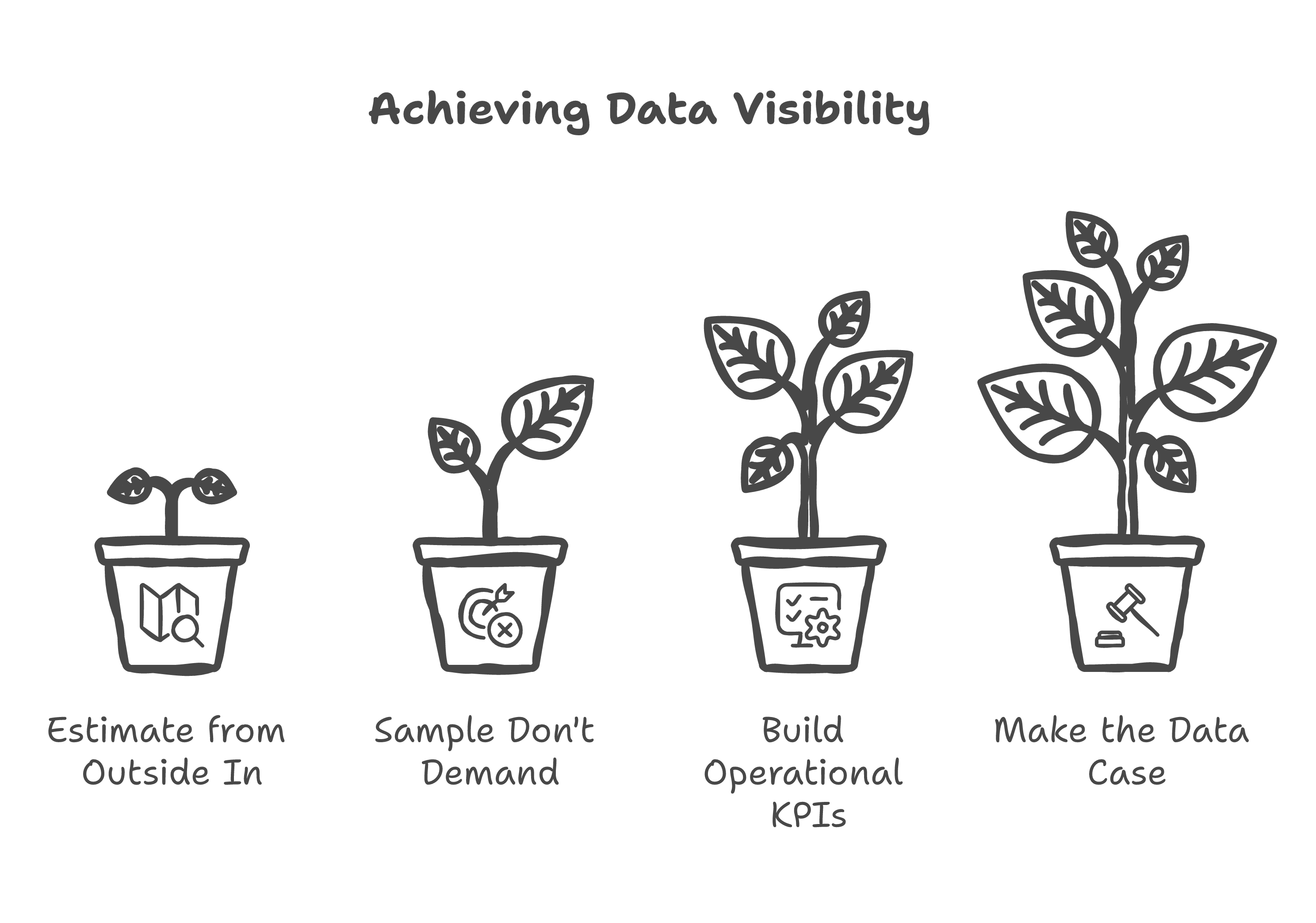
Step 1: Estimate From the Outside In
You don’t need access to every system to build a rough operational picture. Start with what you can observe — sales volume from available indicators, headcount from the org chart, facility capacity from a walk-through, verbal history from conversations with management.
Rough math is better than no math. If the company does approximately $30M in revenue across three product lines, and management says “about 60% comes from widgets,” you already have more segmentation than the P&L gives you.
Step 2: Sample, Don’t Demand
Instead of requesting a full data dump, ask for samples. Pull unit economics from a handful of transactions. What does it cost to produce one unit? What’s the fully-loaded cost of serving one customer?
A sample of 20-30 transactions can reveal patterns that a summary P&L hides for years. The building block for everything: direct costs for a “unit” — whether that’s a product, a project, or a customer engagement.
Step 3: Build Operational KPIs That Don’t Require Financial Access
Some of the most valuable metrics don’t live in the financial statements at all. Employee turnover by department. Customer response times. Production throughput. On-time delivery rates. Quality defect rates.
Management is usually willing to share these because they don’t feel like “financial data.” But they tell you more about the health of the business than any income statement. If turnover in the warehouse is 40% but only 10% in engineering, you’ve identified a problem costing six figures annually — and you never touched the P&L.
Step 4: Make the Data Case
Once you’ve assembled operational data from the first three steps, show management what visibility reveals. Not as a gotcha. As a demonstration of value.
“Here’s what I’ve pieced together about unit economics in your top product line. Here’s where I think we’re losing margin. Here’s a question I can’t answer without your help.”
That framing turns the data conversation from adversarial to collaborative. You’re not the auditor demanding access. You’re the operator showing what’s possible. Garbage assumptions in, garbage strategy out.
The Stakes
A value creation plan without operational data isn’t a plan — it’s a set of assumptions waiting to be disproven. Every thesis about margin expansion, revenue growth, and operational efficiency depends on understanding how the business works at a granular level. Without that, you’re executing against financial summaries — trailing indicators of operational decisions that already happened.
The companies that solve visibility in the first 90 days can allocate resources to the right places, identify problems before they hit the P&L, and demonstrate value to skeptical management teams. The companies that don’t spend the first year reacting to surprises that weren’t surprises — just things nobody could see. A key customer churns. A product line bleeds margin for three quarters. The problems were visible all along, if anyone had been looking at the right data.
The value creation plan starts before the data is clean. It starts the moment you decide to build visibility instead of waiting for someone to hand it to you. If you want to know what the manual status quo costs, calculate your reporting drag.
Alex Escoriaza helps PE-backed companies turn messy data into operational clarity. If you’re navigating the post-close data gap, reach out.