

Search “analytics roadmap” and the same document comes back forty different times: assess maturity, strategize, implement, govern, repeat next fiscal year. It’s the version every consultancy sells, built for a company that expects to exist in its current form indefinitely.
PE-backed companies don’t have indefinitely. They have a hold period, three to five years, sometimes less, and a specific set of people who need to see progress inside that window: the board, the operating partner, and eventually a buyer. A generic analytics roadmap doesn’t know any of that exists. It treats data maturity as the goal instead of the tool.
That’s not a small gap. It’s the reason so much analytics roadmap content ranking well right now converts nobody in this world: it’s answering a question nobody on a hold-period clock is actually asking. Search the phrase and results skew toward companies that plan to exist forever, enterprises building a five-year data platform, mid-market firms slowly professionalizing IT. None of that content is wrong, exactly. It’s just built for a company that isn’t yours.
The Three Deadlines a Generic Analytics Roadmap Ignores
A normal company building a data roadmap has one real constraint: budget. A PE-backed portco has three, and none of them are optional.
The first is the next board meeting. Whatever you’re building has to produce something defensible in 60 to 90 days, not a year from now. The second is the 100-day plan: the document that already committed you to specific operational wins, whether or not the underlying data existed to measure them when the ink dried. The third is exit, quietly the deadline that matters most and gets planned for least. Everything you build in year one either becomes evidence in the data room in year four, or it becomes something you have to explain away.
Say the fund’s model assumed EBITDA margin moving from 8% to 14% over the hold period. That’s the north star metric. Everything the roadmap builds in the first stretch should be able to answer, directly, whether that trajectory is real — not whether the CRM is fully adopted or the warehouse is finally clean.
Generic roadmap content, the kind built for permanence, plans around none of this. It assumes you have the runway to mature slowly: get the infrastructure right, then the dashboards, then the governance. In a hold period, that sequence is backwards. You don’t have five years to earn the right to answer basic questions. You have a board that wants an answer at the next meeting.
None of this means skip the fundamentals. A clean data model still matters, and a roadmap that ignores infrastructure entirely will collapse under its own weight by month eighteen. It means the fundamentals get built in service of the three deadlines, not ahead of them — the warehouse gets built because the thesis metric needs it, not because a maturity model says warehouses come first.
What the Roadmap Actually Needs to Prove
Start with the deal thesis, not the maturity curve. Every acquisition gets bought on a specific story: margin expansion through pricing discipline, cross-sell across an existing customer base, consolidation savings across a roll-up. That story is what the analytics roadmap exists to prove or disprove, on a clock the sponsor set before you showed up.
This is where most roadmap engagements go wrong before they start. Analytics roadmap consulting sold by the big shops tends to open with a capability assessment, where does this company sit on our five-stage model, instead of the deal thesis itself. It’s a fine question for a company with no clock. It’s the wrong first question for one that has three years and a specific number it needs to hit.
Imagine a roll-up buying its fourth platform company. The deal thesis is consolidation savings: one back office instead of four. A generic roadmap says unify the data warehouse in year one. A hold-period roadmap says first prove, inside 100 days, that the four back offices are actually redundant — headcount by function, cost by process, side by side. If they’re not redundant, unifying the warehouse doesn’t matter. If they are, that comparison becomes the case for the next eighteen months of integration work. Without that discipline, rollup data chaos compounds quietly until exit diligence forces the reckoning.
Before sequencing anything, you need an honest read on where you’re starting from, not a generic one: what data actually exists, what’s usable versus just present, and how wide the gap is between what the board wants to see and what the business can currently show them. The reporting drag calculator puts a dollar figure on the manual-reporting side of that gap in about two minutes. That’s the input. The roadmap is what you build from it.
Most operators overestimate what’s usable and underestimate what’s missing. The ERP might have five years of transaction history, but if it’s never been mapped to the specific cohort or product line the deal thesis depends on, that history doesn’t help you at the next board meeting. Skipping the honest read is how roadmaps end up sequenced around what’s easy to pull instead of what actually needs proving.
The Four-Phase Roadmap for a Hold-Period Clock
The roadmap that survives a hold period isn’t organized by data maturity. It’s organized by what has to be true at each checkpoint the sponsor already set.
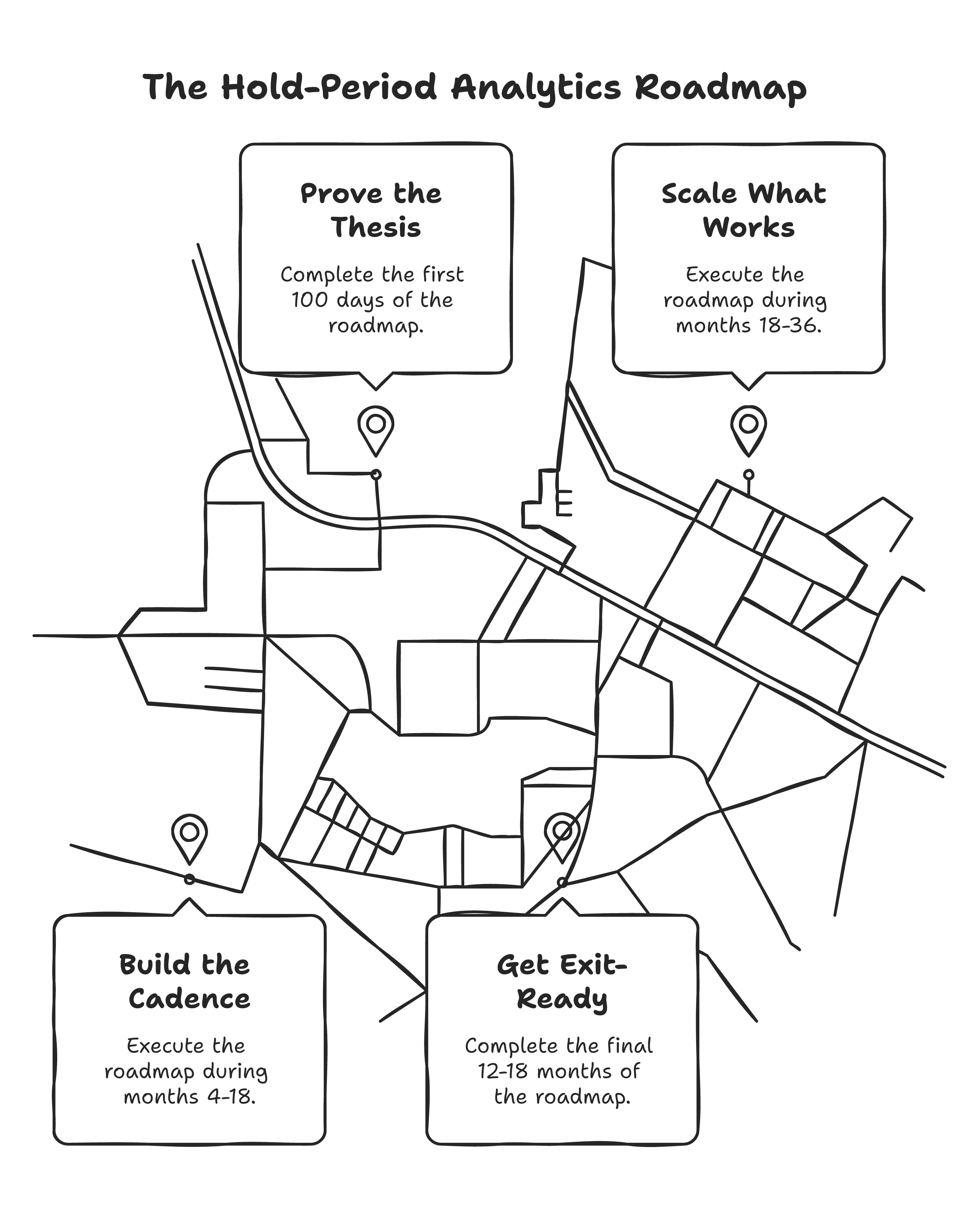
Prove the thesis (first 100 days). Identify the three to five numbers that either validate or kill the reason this deal got done. Not a full reporting suite, the specific metrics tied to the thesis, built fast enough to show up in the first board update. This is the data layer operators need from Day 1 — not a full platform, just visibility into whether the thesis is real. This phase is triage, not architecture, and that means manual is fine: a spreadsheet somebody exports from the ERP every Friday will prove or kill the thesis just as well as a platform would, and it’s ready in week two instead of month six. If the deal thesis is pricing discipline, that means realized price by SKU or contract, tracked weekly, before anyone touches a dashboard tool. Everything else waits.
Build the cadence (months four through eighteen). This is where the manual export has to become a platform, because a spreadsheet somebody remembers to pull every Friday doesn’t survive month eight, let alone month eighteen. The thesis metrics need a rhythm: the same numbers moving from the board deck down to the people who can actually move them, on their own, without someone manually refreshing a file. That means an always-on system pulling the same numbers daily, not a person doing it weekly by hand. We’ve written before about how board-level KPIs cascade down to metrics a shop-floor team can act on; this phase is where that cascade gets built, and the daily-frequency platform underneath it is what makes the cascade something people can trust instead of something they have to double-check. Skip it and the thesis metrics stay a slide nobody below the C-suite has ever seen.
Scale what works (months eighteen through thirty-six). This is where merging the data model and the business model actually pays off, and it’s also where the platform built for the board cadence starts earning its keep twice over. The same always-on data feed that powers the weekly board update now powers dashboards for the functions actually running the business, standardized reporting across every location instead of one, and, once that daily data is trustworthy, the AI use cases that get pitched at every board meeting and rarely ship, because most AI pilots fail for the same reason: the data underneath them was never organized to begin with. Skip the roadmap and you end up stuck in AI pilot purgatory — deploying tools without the data foundation to make them useful. You also start benchmarking against real sector performance instead of only your own history. The knowledge gap that keeps most portcos from doing this well is usually the reason scaling stalls here. A roll-up that proved consolidation savings in its first two platform integrations should be applying the same playbook to the third and fourth, not reinventing the analysis each time.
Get exit-ready (final twelve to eighteen months). The data room doesn’t want a roadmap anymore. It wants a trend line: clean, defensible, multi-year evidence that the thesis played out the way the deal model said it would. If the first three phases were sequenced right, this phase is mostly packaging — pull the same metrics you’ve been tracking since month one and let three years of consistency do the arguing. If they weren’t, you’re reconstructing history under time pressure, hunting for numbers nobody tracked consistently. This is where platform underinvestment surfaces as a valuation problem.
The Mistake: Building Around Tools Instead of Decisions
The failure mode that shows up in almost every stalled roadmap isn’t a bad tool choice. It’s sequencing the roadmap around tools and dashboards instead of the three or four decisions the board actually needs made faster.
A new BI platform doesn’t answer “is the pricing initiative working.” A data warehouse doesn’t tell the operating partner whether the add-on integration is on track for the next update. Those are decisions, not systems, and a roadmap built around what gets deployed instead of what gets decided will hit every one of its milestones and still leave the board asking the same question it asked eighteen months ago: how do we actually know? This is how companies end up building models nobody uses — technical success, operational failure.
Imagine a portco eighteen months into a hold, standing in front of the board with a fully implemented BI platform, three connected data sources, and a suite of dashboards nobody outside finance has opened. Every roadmap milestone got hit on schedule. The board still can’t answer whether the thesis is playing out, because the roadmap was never built to answer that. It was built to deploy a tool. That’s the default outcome of any roadmap that starts with “what should we implement” instead of “what do we need to know.”
That gap is the messy middle of a hold period, the stretch after the deal closes and before results are undeniable, where the roadmap either builds real visibility or just adds infrastructure nobody asked for. The CEO who never leaves the office is often stuck there — managing from the spreadsheet because the operational data doesn’t exist yet. You didn’t take this job to run a data transformation project on top of the operating one. Most operators didn’t sign up for two jobs when they accepted one. The roadmap should reduce that burden, not add to it.
The Stakes
The fund that sequences its portco roadmaps around the deal thesis gets a board that trusts the numbers earlier and an exit story that mostly writes itself. The fund that sequences around data maturity gets a portco three years into ownership that still can’t say, cleanly, whether the reason it bought the company is actually true. It finds that out at the worst possible moment, when a buyer’s diligence team asks the same question the board should have been asking since month one.
There’s a version of this article that ends with a warning about falling behind. That’s not really the risk here. The risk is quieter: spending a hold period’s worth of budget and attention building something technically correct that never once answers the question the deal was actually betting on.
If you’re not sure where your company sits on that spectrum, calculate your reporting drag — it takes less time than the meeting where you have to explain to the board why you don’t know yet. And if you already know the gap and want the full roadmap built around your specific deal thesis and hold-period clock, that’s exactly the engagement I run.
Alex Escoriaza helps PE-backed companies build analytics roadmaps that survive a hold period, not just a board meeting. Reach out to talk through where yours should start.