

Every small-business deal book has the same centerpiece: a trailing-twelve-month P&L, exported from QuickBooks, formatted by the broker, tying neatly to the asking price. Revenue trending up. Margin holding steady. Add-backs helpfully itemized in a separate column.
Here’s the problem with that document. The seller built it for their own purposes, over years when selling wasn’t even the plan. Then it was polished during the one year when it was.
Buyers in the $1M-$10M range learn this after the wire clears, and they describe it in almost identical language. One buyer of a small service business put it this way: “I was shown cooked books and inaccurate finances on how profitable the business was. Suddenly I realized I bought a sinking ship, and it took me down with it.”
Read enough of these accounts and the impression hardens: buyers at this size discover post-close, again and again, that the financials they trusted at signing were optimized, edited, or in some cases invented. The useful questions are how badly the books are cooked, and whether you find out before or after you own the answer.
The Pattern Plays Out the Same Way Every Time
Strip the industries away and the sequence barely changes.
A buyer finds a target. The numbers look attractive. The seller is friendly, often a tired owner who “just wants to enjoy retirement.” A diligence process runs its course and raises no flags. The deal closes. Then, somewhere between month one and month six, reality starts arriving in envelopes.
One buyer closed on a convenience store after exactly that kind of process, then watched sales drop to “barely covering rent” within weeks of taking over. He reached for external explanations: timing, tourism, the economy. An experienced operator reading his account offered the blunter read: the numbers were fixed, and now they were coming to a head.
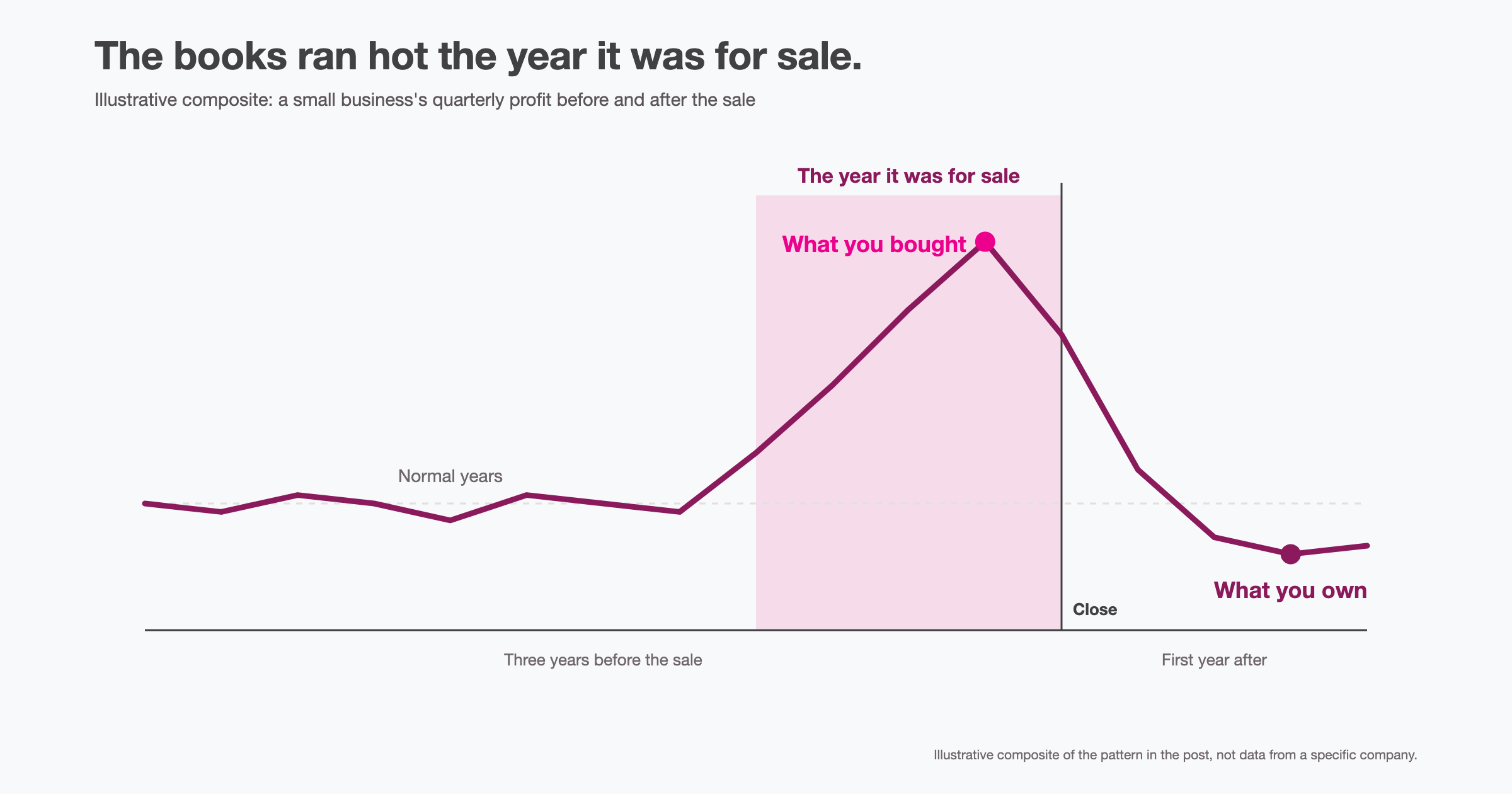
Whether or not that was the whole story in his case, the mechanism it points to is standard practice. A seller runs the trailing twelve months hot: books sales aggressively, defers expenses, leans on every lever that makes the listing presentable. The new owner inherits the regression to the mean.
Then there’s the operator who became executor of his father’s metal fabrication company after a sudden death. He had worked there his whole adult life and thought he knew the business. What he didn’t know was that the long-time bookkeeper, kept on because she was cheap and “loyal,” had been sporadic with payroll tax filings for years. The QuickBooks file was mysteriously corrupted at the worst possible moment. When he logged into the IRS website, there was a lien for almost a million dollars.
These stories sit in the middle of the distribution: the ordinary outcome when a buyer relies on the seller’s books and a thirty-day review.
Why “The Numbers Were Fixed” Is the Default
The instinct after reading these stories is to assume sellers are crooks. Some are. Most aren’t. The truth is more uncomfortable and more useful: the seller’s books serve the seller’s purpose, which for years has been some combination of three things.
Tax minimization. Every dollar of expense run through the business is a dollar that doesn’t get taxed. Personal vehicles, family cell phones, a kid’s “summer internship,” the boat used “for client entertainment.” Sellers will tell you these are add-backs you should normalize out. Some genuinely are. Many aren’t, and the line between “owner benefit” and “the business needed this expense to run” is fuzzy on purpose.
Cash management. Owners pull cash. They time deposits. They pay vendors late when it suits them and accelerate collections when it doesn’t. Cash-basis books tell a story that accrual books won’t, and most $1M-$10M businesses run on cash basis because it’s simpler and tax-advantaged. Neither reason has anything to do with showing how the operation performs.
Sale prep. Anyone who has talked to a business broker knows the playbook for “getting the books ready.” Suddenly there are no discretionary expenses. Suddenly the owner stops paying himself a real salary. The trailing twelve months presented to buyers are almost never representative of the four years before that.
The accountant doing your Quality of Earnings review answers a narrow question when they bless the numbers: do these statements accurately reflect what’s in QuickBooks? The answer is usually yes. What’s in QuickBooks is the problem. They’re not walking the floor, calling vendors, or pulling the audit log to see what got deleted in March.
Nobody on a standard deal team is paid to check whether the operation underneath matches the statements. PE firms have the same hole at fifty times the deal size: operational diligence is the review that gets skipped at every level of the market. At the $1M-$10M level, it’s not even offered.
What To Actually Check Before You Sign
If you’re going to write a check for a privately held business, you need a verification layer that sits underneath the QoE and looks at the business through a different lens: the operation itself.
Per-unit and per-location P&Ls alongside the consolidated one. A consolidated P&L can hide a multitude of sins. One profitable location can cover for two that are bleeding. Ask for the breakdown. If the seller doesn’t have it, that’s information too: the business has never been run at the unit level, and you’ll be the first to try.
Cash vs. accrual reconciliation. Run both, side by side, month by month, for at least 24 months. Pre-close, the gap between them is a forensic instrument: its shape tells you when revenue was pulled forward and when expenses were parked. A narrow, stable gap means the seller knew what they were doing. A wide, lumpy one means somebody was timing things, and you need to know why.
Vendor aging reports and unopened mail. The unglamorous check that catches the most surprises. Pull the AP aging at thirty, sixty, ninety, and 120+ days. Then call the vendors directly, because the AP report only shows what got entered into the books. “$80K in unpaid supplier bills, discovered five months post-close” is the kind of surprise that doesn’t survive a real vendor confirmation call. Ask the seller for the last six months of unopened mail. You’d be surprised how often the answer is a slightly embarrassed pile.
Payroll tax compliance verification. This is the one that takes companies down. The IRS does not care that you didn’t know. Pull the EFTPS payment history directly. Pull state withholding confirmations. Cross-check 941s against actual deposits. The metal fabrication company’s bookkeeper looked fine on paper for years. The signal was in the actual filings.
QuickBooks audit log review. The check most buyers don’t know exists. Every QuickBooks file logs every change: who logged in, what got modified, what got deleted, when. A bookkeeper who suddenly “loses” the file the month before closing is telling you something. So is a pattern of last-day-of-month journal entries that move expenses around. Free, fast, and devastatingly informative.
Customer concentration and contract verification. Don’t accept the customer list at face value. Pull the actual contracts. Call the top five customers and ask about renewal intent, framed as a new-owner introduction. Concentration risk is the silent EBITDA killer in the lower middle market, and it almost never shows up cleanly in the data room.
The Cost of Not Checking
The math here is uncomfortable, which is exactly why it matters.
A real operational diligence layer (vendor confirmations, audit log review, payroll tax verification, unit-level P&L reconstruction) runs roughly the same order of magnitude as the QoE itself. Sometimes less.
The cost of skipping it ranges from annoying to ruinous. On the low end, you absorb tens of thousands in hidden vendor liabilities in year one, which eats your operating margin and the cash buffer you were counting on. On the high end, you inherit a seven-figure IRS lien and spend two years on liability questions that pull you away from running the company.
Even the annoying outcomes change the deal economics. If you raised SBA money against a model that assumed the trailing EBITDA was real, and the real number is noticeably lower once you’ve stripped the optimistic add-backs and found the buried expenses, the debt service math gets uncomfortable fast. “I didn’t sign up to cover someone else’s debts” is a sentiment that shows up in every one of these accounts, usually right before the buyer realizes they did, in fact, sign up for exactly that.
The worst case is the compounding visibility problem. You don’t know what you don’t know about the business you now own, so for six months you make decisions on inherited assumptions that turn out to be wrong. Staffing calls, vendor calls, pricing calls, all on bad information. Every buyer fights some version of the data access problem that dominates the first months of ownership; the org chart has its own flavor in the workforce surprises diligence reliably misses. The ledger version is the one you fund personally.
Speaking as someone whose own search ended with a deal that didn’t close: even the “good” version of finding this stuff late costs you the first year. You spend it correcting for problems you should have priced in before signing.
Go Back to the Deal Book
Take another look at that trailing-twelve-month P&L. Every number on it was entered by someone, for a reason, and the reason was never “help the future buyer see clearly.” Then ask who on your deal team is paid to test the numbers against the operation, beyond confirming that the statements add up.
If the answer is nobody, what you have is an expensive group hug.
The buyers in these stories did the standard work. They had accountants, lawyers, SBA underwriters, and signed letters of intent. What they didn’t have was anyone walking underneath the financials to check whether the operation matched the document. That gap is where the cooked books live. Close it before you sign. It’s a lot cheaper than closing it after.
Alex Escoriaza runs the verification layer under the QoE for buyers and independent sponsors (audit logs, vendor confirmations, unit-level P&L reconstruction) before the wire clears. If you’re circling a target and the deal book looks a little too clean, let’s talk.