

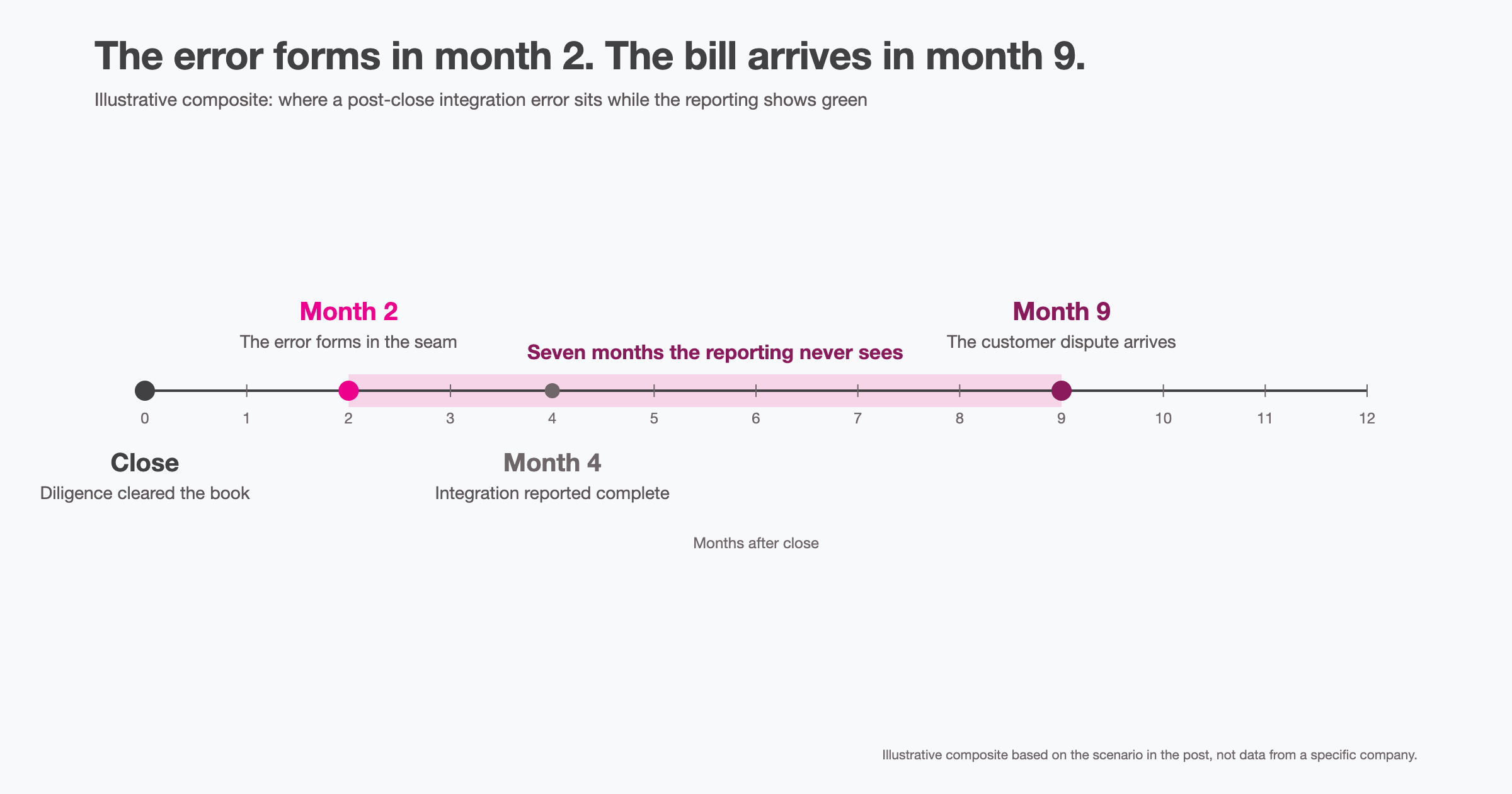
Diligence cleared the book. The reps and warranties covered what the seller knew, the escrow was sized for everything the lawyers could name, and by month four the board deck called the acquisition substantially integrated.
Month nine, a customer calls. The renewal they were promised never processed, or the term they negotiated with the old owner never made it across the seam between two companies. That sequence is a composite, but every piece of it is routine. The error happened in month two, in a system nobody reconciled. The complaint arrived seven months later, after the integration team had moved on, and the first claim became a line in the legal budget.
Nobody in that sequence is being careless. The error and its consequence are separated by enough time that the second looks unrelated to the first.
The Error Formed Where Nobody Was Looking
The month-two error sat somewhere the reporting doesn’t look: the seam between two companies’ systems, records and people.
Integration reporting tracks the plan. Systems cut over, roles filled, synergies booked, all green by month four. None of those measures checks whether what the acquired company promised its customers still matches what the combined company actually does. Diligence can’t check it either, because at signing the gap doesn’t exist yet. It forms after close, during the migration, under new management.
That makes it a visibility problem, and a slow one. The error and the bill are months apart, so by the time a dispute shows up, nobody traces it back to the integration.
Insurance is one of the few industries that keeps score, because the errors come back as errors-and-omissions claims with a date attached. Agency acquisitions have accelerated, and the agents’ national trade association has watched the claims follow. Nancy Germond, who leads its risk management and education work, put the pattern in one line: “Agency E&O claims that arise are lagging indicators. We’re seeing claims arise after mergers.”
Most acquirers never get that scorecard. The same error shows up as a billing dispute, a write-off, a compliance finding or a customer who quietly leaves, and none of it carries the deal’s name. The lag is identical. The record of it is missing.
Three Seams Your Reports Don’t Watch
The exposure collects in three places. The examples below are illustrative composites, there so you can map them to your own business.
1. Systems that don’t reconcile
You acquire a regional services business with its own scheduling and invoicing stack. Both run in parallel while the migration is planned, and service commitments entered in the acquired system never sync to the one your account managers now use. Customers get billed on terms that no longer match their contract, or never get scheduled. One missed commitment is an annoyance. A pattern of them, documented in the customer’s own records, is a dispute.
Each side’s data looks internally consistent. The gap lives between them, which is where nobody is looking. No report built for either company was designed to compare the two.
2. Records nobody has reviewed since close
Diligence confirmed the contracts were on file. Whether each one still says what the customer was promised is a separate question, and after close nobody owns it.
Most companies review a record when the calendar forces it open: the quarter-end, the annual contract review, the vendor re-bid, the compliance filing. Wait for those moments and the errors you inherited and the errors you introduced accumulate for most of a year. A contract on file passes the existence test. Existence does not equal utility.
3. Knowledge that was never written down
I’ve written about the post-close turnover that diligence routinely misses, where the cost was the value creation plan. The cost here is the error-prevention layer.
The ops manager who knew which customer had a non-standard arrangement, the controller who knew which accounts needed a manual adjustment, the account rep who knew one contract carried an exception: all of it lived in people’s heads, and it left when they did. The errors that follow arrive months later as disputes and compliance findings, with no line connecting them back to the departure.
The three compound. Systems that don’t reconcile produce the errors, unreviewed records let them sit, and the people who used to catch them are gone. Each is manageable alone. Together they produce the curve insurers can see in their claims data, in businesses that keep no such record.
Turn the Lag Into a Leading Indicator
Germond’s fix for acquired agencies is a schedule: review a tenth of the acquired book every month and confirm the coverage is right, without waiting for each policy to come up for renewal.
Ten percent a month covers the whole acquired book in ten months, on your schedule, with findings you can act on while the exposure is small.
In a portco the schedule is a data exercise, and running it means answering four questions you may not be able to answer today.
What is the book? The inventory of what you are reviewing: customer contracts, vendor agreements, compliance obligations, pricing commitments, service terms. In many acquired companies that inventory is a folder structure, a CRM nobody trusts, and three people’s memories. Building the list is the first finding.
What does good look like for each item? A correct contract, a compliant record, a properly billed account, each written down as a standard someone can check against. If two teams would disagree about whether a given account is right, figure out what good looks like before the review starts, or the findings will mean nothing.
Which 10% goes first? Random sampling is fine for a baseline. Risk-weighted is better: the largest accounts, the ones with non-standard terms, the ones whose relationship-holder has left, the ones that crossed the system seam during migration. The three seams above are the sort order.
What does the error rate tell you over time? This is the piece that turns a lagging indicator into a leading one. Log every finding by type: system mismatch, unreviewed record, undocumented knowledge. Month over month, the rate and the mix tell you whether the integration is closing the exposure or moving it around. A declining rate is evidence you can put in front of a board. A flat one is a warning you get in month four, before it becomes a dispute you get in month fourteen.
None of this needs new software to start. A shared list with one row per item, an owner, a last-reviewed date and a finding type is enough for the first quarter. The schedule is the discipline. Tooling can come later.
This schedule either gets built in the early post-close window or gets displaced by everything else. I’ve argued that the first weeks after close set the operating cadence for the next eighteen months. The review schedule belongs in that cadence from the start.
Integration Is a Visibility Problem
Most post-close integration work is justified on an efficiency case: consolidate systems to save cost, standardize process to free capacity, retain people to protect the plan. All true.
The same seams carry a second cost that matures after the integration team has declared victory. At the growth rates PE deals now have to deliver, there is no slack in the plan to absorb a cluster of disputes, a compliance finding, or a customer segment that quietly stopped renewing.
Go back to the opening. The reps and warranties covered what the seller knew, and the escrow was sized for what the lawyers could name at signing. None of that touches a renewal your own migration dropped, or a commitment your own new hire never knew existed. Those errors happened after close, under your management. They are yours.
You can’t indemnify what you can’t see. You can schedule the looking. Ten percent a month, against a definition of good, with the findings logged. One question to take into your next integration review: which parts of the business you just bought has anyone reviewed since close, and who would know if the answer is none?
Sources: Insurance Business, reporting on the Independent Insurance Agents & Brokers of America (Nancy Germond, Mar 2026).
Alex Escoriaza helps PE-backed companies build the inventory, the definitions, and the audit cadence that make post-acquisition exposure visible before it becomes a claim. If your integration plan has a systems workstream and a people workstream but no review schedule for what you bought, that is the work I do. Even if it isn’t me, get the schedule built. Tell me what the book looks like.